

Introduction
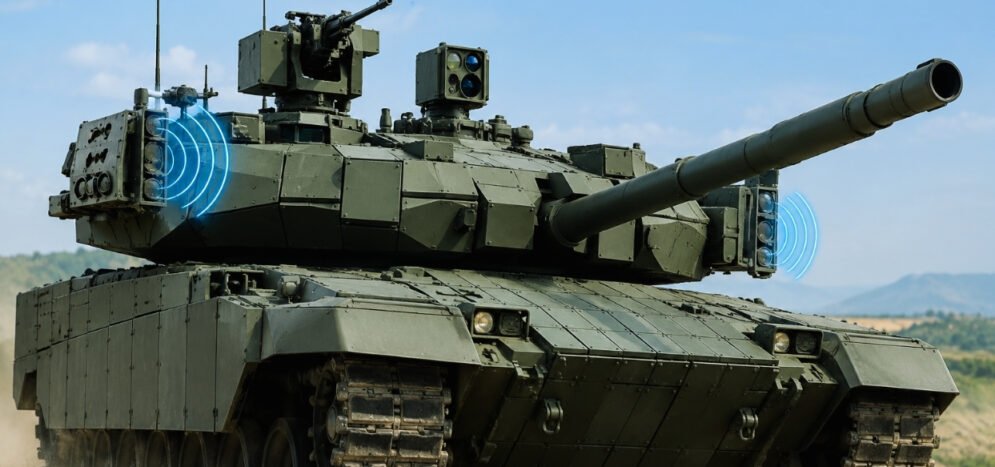
Active Protection Systems (APS) technologies are transforming the survivability of modern military vehicles by providing a defensive layer designed to detect, track, and counter incoming threats before they reach the platform. Traditionally, armored vehicles have relied on passive armor, reactive armor, camouflage, and other protective measures to withstand attacks. However, the growing sophistication of anti-tank guided missiles (ATGMs), rocket-propelled grenades (RPGs), loitering munitions, and other precision weapons has increased demand for more dynamic protection solutions.
APS technologies combine sensors, electronic processing, tracking systems, and countermeasures to identify incoming threats and respond within extremely short timeframes. These systems are increasingly being integrated into main battle tanks (MBTs), infantry fighting vehicles (IFVs), armored personnel carriers (APCs), and other high-value military platforms.
The development of APS is also being influenced by the changing battlefield environment. Modern conflicts demonstrate that armored vehicles face threats from multiple directions and across different ranges. Consequently, defense manufacturers are developing systems capable of detecting and responding to increasingly diverse threats while maintaining compatibility with existing vehicle architectures.
What Are Active Protection Systems?
An Active Protection System is a defensive technology designed to protect a military platform by detecting an incoming threat and taking action to defeat, disrupt, or divert it. Unlike conventional armor, which passively absorbs or deflects an impact, APS attempts to intervene before the threat reaches the vehicle.
A typical APS consists of several interconnected components. Sensors continuously monitor the surrounding environment for potential threats. Radar systems can detect and track fast-moving projectiles, while electro-optical and infrared sensors can provide additional information for threat identification. A central processing unit analyzes sensor data and determines whether an object represents a genuine threat.
Once a threat is classified, the system can activate an appropriate countermeasure. Depending on the architecture, this may involve a hard-kill interceptor that physically destroys or disrupts the incoming projectile, or a soft-kill response that interferes with the weapon’s guidance or targeting mechanism.
The ability to complete detection, classification, tracking, decision-making, and engagement within fractions of a second is one of the defining characteristics of APS technology.
Major Active Protection Systems Technologies
APS technologies are generally divided into hard-kill and soft-kill systems, although modern architectures can combine both approaches.
Hard-kill APS systems use physical countermeasures to defeat incoming threats. When a radar or sensor detects an approaching projectile, the system calculates its trajectory and determines whether it poses a danger to the protected vehicle. If the threat meets engagement criteria, an interceptor is launched to destroy, deflect, or disrupt the projectile before impact.
Hard-kill systems can provide protection against threats such as ATGMs and RPGs. Their effectiveness depends on sensor accuracy, reaction time, engagement geometry, interceptor performance, and the ability to operate against multiple simultaneous threats. Designers must also ensure that interceptors can be safely deployed around friendly personnel and nearby vehicles.
Soft-kill APS technologies take a different approach. Instead of physically destroying an incoming weapon, they attempt to interfere with its ability to locate, track, or strike the protected platform. Electronic jamming, infrared countermeasures, multispectral obscurants, and decoy technologies can form part of a soft-kill architecture.
Soft-kill systems are particularly relevant against guided weapons that depend on sensors or electronic guidance. By disrupting the weapon’s targeting process, the system may cause the threat to miss its intended target.
A growing trend is the development of hybrid APS architectures, which combine hard-kill and soft-kill capabilities. This approach allows platforms to select an appropriate response depending on the type of incoming threat.
Sensors and Threat Detection
Sensors represent one of the most important elements of APS technology. The system must detect an incoming threat early enough to provide sufficient time for tracking and engagement.
Active electronically scanned array (AESA) radars are increasingly relevant because they can provide rapid scanning and tracking capabilities. Radar sensors can detect projectiles approaching from different directions and provide information about their speed, trajectory, and estimated point of impact.
Electro-optical and infrared sensors provide another layer of situational awareness. These technologies can support threat recognition and help distinguish between potential threats and non-threatening objects. Combining different sensor types can improve system resilience because individual sensors may have limitations under particular environmental conditions.
Sensor fusion is therefore becoming a major area of APS development. Data from radar, infrared, electro-optical, acoustic, and other sensors can be processed together to create a more comprehensive picture of the battlefield.
Artificial intelligence and machine-learning technologies are also being explored to support automated threat classification and decision-making. Faster data processing can reduce the time between detection and response, although system designers must maintain strict reliability and safety requirements.
Countermeasure Technologies
Countermeasures are the final stage of an APS engagement sequence. Hard-kill interceptors are engineered to engage incoming projectiles at a calculated point before they reach the vehicle. Their design must account for extremely short engagement windows and varying threat trajectories.
Soft-kill technologies, meanwhile, focus on disrupting the attacker’s targeting process. Electronic warfare capabilities can interfere with certain guidance systems, while multispectral smoke and obscurant systems can reduce the attacker’s ability to maintain a target lock.
The development of new countermeasures is closely connected to the evolution of threats. As anti-armor weapons become more maneuverable and sophisticated, APS manufacturers must develop faster detection, improved tracking, and more flexible response mechanisms.
APS Integration With Modern Military Vehicles
Integrating APS onto armored vehicles presents significant engineering challenges. The system must operate alongside existing armor, communications equipment, electronic warfare systems, weapons, and vehicle electronics.
Weight, power consumption, ammunition storage, sensor placement, and vehicle dimensions are important considerations. APS components can add additional weight and require electrical power and physical space. Therefore, manufacturers increasingly focus on modular architectures that can be adapted to different vehicle platforms.
Network connectivity is another important development. APS can potentially share threat information with other vehicles and battlefield systems, contributing to broader situational awareness. Integration with battle management systems could allow commanders and crews to receive information about detected threats and changing battlefield conditions.
Modern APS development is therefore moving beyond standalone vehicle protection toward interconnected defensive architectures.
Challenges and Future Development
Despite technological advances, APS faces several challenges. Modern battlefields can contain multiple simultaneous threats, including missiles, rockets, drones, loitering munitions, and kinetic projectiles. A system must be capable of prioritizing threats while avoiding unnecessary engagements.
Urban environments create additional difficulties because buildings, civilians, friendly forces, and other vehicles can restrict engagement opportunities. False alarms and sensor interference can also affect performance.
Another challenge is the emergence of top-attack weapons and unconventional attack profiles. Traditional APS configurations may need additional sensors and interceptors to provide comprehensive coverage against threats approaching from different angles.
The future of APS is likely to involve greater integration of radar, electro-optical sensors, electronic warfare, artificial intelligence, and networked battlefield systems. Directed-energy technologies may also become relevant as militaries explore alternative methods for countering selected threats.
Unmanned ground vehicles could represent another emerging application. As autonomous and remotely operated platforms become more common, APS could provide an additional layer of protection while reducing the need for human operators to make immediate defensive decisions.
Conclusion
Active Protection Systems technologies are becoming an increasingly important component of modern armored vehicle survivability. By combining advanced sensors, automated threat detection, rapid processing, and hard-kill or soft-kill countermeasures, APS can provide a defensive layer beyond conventional armor.
The evolution of anti-armor weapons, drones, loitering munitions, and precision-guided threats is encouraging continued investment in APS development. Future systems are expected to become more modular, networked, automated, and capable of addressing a broader range of threats.
As military platforms evolve toward increasingly connected and digitally enabled architectures, Active Protection Systems are likely to play a significant role in the next generation of battlefield survivability and armored vehicle technology.