

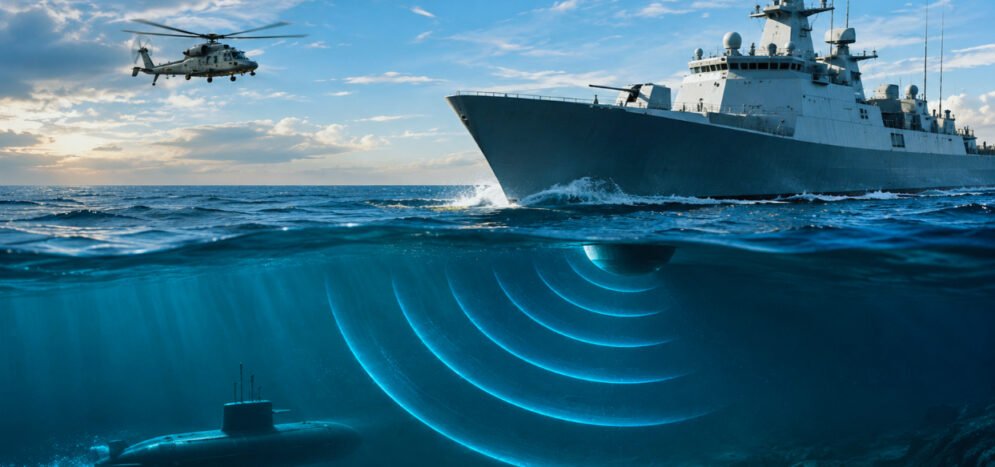
Underwater surveillance and detection have become increasingly important for modern naval operations, maritime security, and underwater defence. As naval forces face evolving threats from submarines, unmanned underwater vehicles (UUVs), and other underwater platforms, advanced detection technologies play a critical role in maintaining maritime awareness. Sound Navigation and Ranging (SONAR) systems have emerged as essential technologies for identifying, tracking, and monitoring objects beneath the water’s surface.
SONAR systems technology uses sound waves to detect underwater objects, measure distances, determine depth, and analyse underwater environments. Unlike radar, which relies on electromagnetic waves, SONAR operates using acoustic signals that can travel considerable distances through water. This makes it particularly valuable for submarine detection, anti-submarine warfare (ASW), underwater mapping, and naval surveillance.
Modern SONAR solutions combine advanced acoustic sensors, signal processing technologies, artificial intelligence (AI), and digital communication systems to improve detection accuracy and operational performance. These developments are transforming how naval forces monitor underwater environments and protect strategic maritime assets.
Understanding SONAR Systems Technology and Its Working Principles
SONAR technology operates by transmitting or receiving sound waves underwater and analysing the acoustic signals to identify objects or environmental characteristics. When sound waves encounter an underwater object, they may be reflected, scattered, or absorbed. SONAR equipment processes the returning acoustic signals to estimate the object’s distance, direction, depth, and movement.
There are two primary categories of SONAR systems: active and passive SONAR.
Active SONAR systems transmit acoustic pulses into the surrounding water and receive the reflected signals from underwater objects. By measuring the time taken for the sound waves to return, the system estimates the distance and location of potential targets. Active SONAR is commonly used for submarine detection, underwater obstacle identification, and seabed mapping. However, transmitting acoustic signals can reveal the operating platform’s presence to other underwater systems.
Passive SONAR systems, in contrast, do not transmit sound waves. Instead, they detect and analyse acoustic signals generated by submarines, ships, underwater machinery, and other sources. These systems are particularly valuable for covert naval surveillance because they allow vessels to monitor underwater activity without actively emitting acoustic signals.
Modern naval platforms frequently use a combination of active and passive SONAR technologies to improve underwater detection and situational awareness. The selection depends on operational requirements, environmental conditions, and the nature of the potential underwater threat.
Types of SONAR Systems and Their Defence Applications
SONAR technologies are available in different configurations to support specific naval missions and underwater operational requirements.
Hull-Mounted SONAR: Installed directly into a vessel’s hull, these systems provide continuous underwater monitoring and support submarine detection, navigation, and anti-submarine warfare operations. They are commonly integrated into destroyers, frigates, and other naval combat vessels.
Towed Array SONAR: These systems consist of acoustic sensor arrays deployed behind a naval vessel using a cable. Their configuration helps reduce interference from the vessel’s own machinery and improves passive acoustic monitoring capabilities. Towed array SONAR is particularly relevant for detecting and tracking submarines over extended surveillance periods.
Variable Depth SONAR (VDS): VDS systems allow acoustic sensors to be deployed at different depths to improve underwater detection under changing oceanographic conditions. They help naval forces address challenges associated with temperature variations, salinity, and sound propagation.
Dipping SONAR: Primarily used by naval helicopters, dipping SONAR systems are lowered into the water using a cable to detect submarines and other underwater threats. They support airborne anti-submarine warfare missions and provide additional detection capabilities for naval task forces.
Side-Scan SONAR: This technology uses acoustic signals to generate detailed images of the seabed and identify underwater objects. It is widely used in mine countermeasures, underwater infrastructure inspection, maritime research, and search-and-rescue operations.
Synthetic Aperture SONAR (SAS): SAS technology combines acoustic measurements collected along a platform’s movement to produce high-resolution underwater imagery. It supports seabed analysis, mine detection, and identification of underwater structures.
Emerging Technologies Transforming SONAR Capabilities
The evolution of SONAR systems is increasingly driven by digital technologies, artificial intelligence, and advanced acoustic processing. These innovations are improving the ability of naval forces to identify underwater objects in complex maritime environments.
Artificial intelligence and machine learning are being incorporated into modern SONAR solutions to analyse large volumes of acoustic information, distinguish potential threats from background noise, and support automated target classification. These capabilities can reduce operator workload and improve the speed of underwater threat assessment.
Advanced signal processing technologies are also enhancing the ability to identify weak acoustic signatures in challenging underwater environments. Digital beamforming, adaptive filtering, and sophisticated acoustic analysis help improve detection performance and target tracking.
The integration of SONAR systems with unmanned underwater vehicles is another important development. UUVs equipped with compact acoustic sensors can conduct underwater surveys, monitor maritime infrastructure, support mine countermeasure operations, and collect information in areas that may be difficult or risky for crewed platforms to access.
Networked underwater surveillance is also gaining importance. Integrating SONAR sensors with underwater communication systems, autonomous platforms, and naval command-and-control networks can provide a more comprehensive picture of underwater activity.
Role of SONAR in Modern Naval Defence and Maritime Security
SONAR systems are fundamental to modern naval defence because they support several critical underwater missions. One of their primary applications is anti-submarine warfare, where naval forces use acoustic detection technologies to locate, classify, and track hostile submarines.
In addition to submarine detection, SONAR plays an important role in naval mine countermeasures. Advanced imaging systems help identify mines and other potentially hazardous objects on the seabed, supporting safer maritime navigation and naval operations.
SONAR technology also contributes to protecting critical underwater infrastructure, including subsea communication cables, offshore energy installations, pipelines, and strategic maritime facilities. Monitoring underwater environments helps identify suspicious activities and potential threats to these assets.
Beyond military applications, SONAR systems are widely used in commercial shipping, hydrographic surveying, oceanographic research, fisheries management, and underwater exploration. These applications demonstrate the technology’s importance across both defence and civilian maritime sectors.
Future Outlook for SONAR Systems Technology
The future of SONAR systems technology will be shaped by increasing investments in naval modernisation, underwater surveillance, autonomous maritime platforms, and anti-submarine warfare capabilities. Growing concerns surrounding submarine activity and the protection of critical underwater infrastructure are encouraging defence organisations to adopt more advanced acoustic detection solutions.
The development of compact, energy-efficient SONAR sensors, AI-enabled acoustic processing, and network-centric underwater surveillance systems is expected to create new opportunities for defence manufacturers and technology providers.
Unmanned underwater vehicles and distributed acoustic sensor networks are also likely to influence future naval operations by extending surveillance coverage and enabling persistent underwater monitoring. Meanwhile, improvements in synthetic aperture imaging, digital beamforming, and advanced signal processing will continue to enhance underwater detection and seabed analysis.
As maritime threats become more sophisticated, SONAR systems will remain an essential component of naval warfare, underwater surveillance, and maritime domain awareness. Continued innovation in acoustic sensing, automation, and intelligent data processing will strengthen underwater operational capabilities and support the next generation of naval defence technologies.
Conclusion: SONAR systems technology is becoming increasingly important in modern maritime defence, providing essential capabilities for underwater detection, submarine tracking, seabed mapping, and infrastructure protection. With advancements in AI, autonomous platforms, and digital acoustic processing, SONAR will continue to play a significant role in strengthening naval capabilities and global maritime security.