
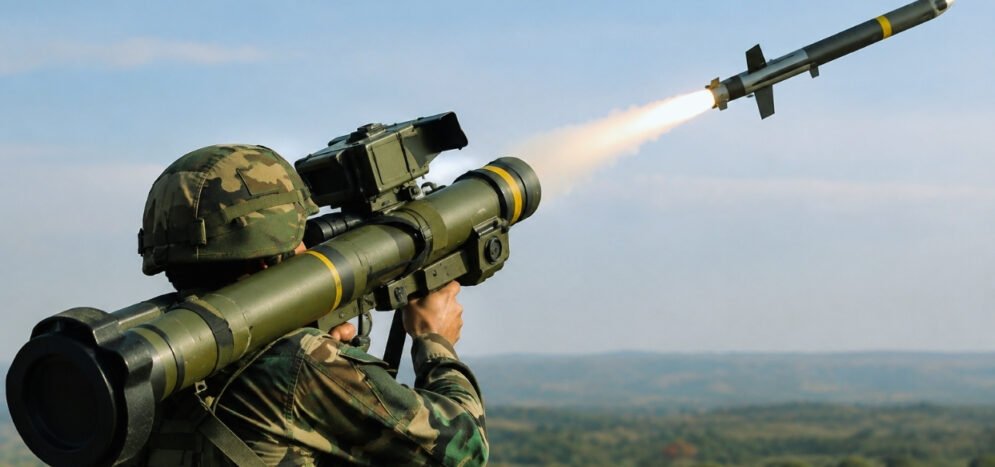
Man-Portable Air Defence Systems, commonly known as MANPAD Technology, represent one of the most important categories of short-range air-defence technology. Designed to engage low-flying aircraft, helicopters and other aerial threats, these systems combine portability with guided-missile technology. Their relatively compact size allows them to be carried and operated by an individual or a small team, giving ground forces a mobile means of defending themselves against aerial attack.
The growing importance of helicopters, low-flying combat aircraft and unmanned aerial systems has renewed interest in portable air-defence capabilities. Modern battlefield environments increasingly demand air-defence systems that can move with troops rather than relying entirely on fixed installations or large vehicle-mounted missile batteries. MANPADS fill this important gap by providing a final layer of short-range protection within a broader integrated air-defence network.
Understanding MANPAD Technology
A typical MANPAD Technology system consists broadly of a guided missile housed in a launch tube, a firing or control mechanism, and a power source such as a battery or battery-cooling unit. Depending on the design, some components may be reusable while others are associated with a single missile round. The compact configuration makes MANPADS significantly more portable than larger surface-to-air missile systems. Official assessments have described typical systems as roughly 1.2 to 2 metres in length and generally weighing in the range that can be carried by an individual or a small crew.
The central technological challenge in a MANPAD Technology is combining multiple advanced functions into a lightweight package. These include target detection, tracking, guidance, propulsion, flight control and terminal engagement. Improvements in electronics, sensors, computing and materials have steadily increased the capability of modern systems compared with early generations.
MANPADS are commonly divided according to their guidance technology. The most widely recognised category is the infrared-guided system, which uses a seeker to detect and track the thermal signature associated with an aircraft. Other systems use command guidance or laser beam-riding principles. In command line-of-sight systems, the operator plays a more active role in guiding the missile, while laser beam-riding systems require the missile to remain aligned with a laser-based guidance path.
Evolution of Guidance and Seeker Technology
The history of MANPAD Technology development is closely linked to advances in seeker technology. Early portable air-defence missiles emerged during the Cold War era, with the first generations relying on relatively simple infrared homing concepts. These early systems represented a major breakthrough because they allowed infantry units to engage aircraft without requiring large radar systems or heavy missile launchers.
Over time, seeker technology became more sophisticated. Modern infrared seekers can process more information about a target and are designed to improve discrimination between genuine targets and environmental interference. Advances in sensor technology have also contributed to improved performance against aircraft using defensive countermeasures.
The seeker remains one of the most important elements in determining the overall effectiveness of a guided portable air-defence missile. According to technical assessments, seeker performance influences target acquisition, engagement geometry, resistance to countermeasures and tracking accuracy.
Another important trend has been the increased use of digital electronics and advanced signal processing. These technologies allow modern systems to make faster calculations and improve the missile’s ability to distinguish between different thermal or optical signatures. The result is a gradual shift from relatively basic heat-seeking missiles towards more sophisticated portable guided weapons.
However, technology alone does not determine effectiveness. Environmental conditions, target characteristics, system maintenance and operator training can all influence real-world performance.
Role of MANPADS in Modern Air Defence
MANPAD Technology are generally considered a component of layered air defence rather than a replacement for larger missile systems. Long-range and medium-range surface-to-air missile systems protect large areas and strategic assets, while short-range systems and MANPAD Technology provide defence closer to troops and critical locations.
Their greatest advantage is mobility. Infantry formations operating in remote or rapidly changing battlefield conditions can carry portable air-defence weapons with them. This makes it more difficult for an opposing air force to assume that only major bases or fixed installations possess air-defence capabilities.
MANPAD Technology have traditionally been associated with threats such as low-flying aircraft and helicopters. Today, however, the wider proliferation of unmanned aerial systems is creating new challenges and opportunities for short-range air defence. Small drones are often difficult to detect and may not present the same signature characteristics as conventional aircraft. As a result, MANPAD Technology are increasingly viewed as one element within a broader counter-drone and short-range air-defence ecosystem rather than as a universal solution.
The expanding use of missiles and uncrewed systems in recent conflicts is also driving renewed attention towards air-defence technologies across all ranges.
Countermeasures and Technological Competition
The development of MANPADS has always been accompanied by the development of aircraft countermeasures. Military aircraft employ a variety of techniques intended to reduce their vulnerability to guided missiles, including warning systems, decoys and other defensive technologies.
This has created a continuing technological competition between missile seekers and aircraft survivability systems. As aircraft countermeasures improve, missile designers seek better sensors, processing and target-discrimination capabilities. Conversely, improvements in MANPAD technology encourage aircraft manufacturers and air forces to invest further in defensive systems.
The situation is particularly significant for helicopters and aircraft operating at lower altitudes. Such platforms may spend more time within the engagement environment of short-range air-defence systems. NATO and other defence organisations have long recognised MANPADS as a significant threat to low-flying military aircraft and helicopters.
Security, Proliferation and Responsible Control
While MANPADS provide legitimate defensive capabilities to national armed forces, their portability creates serious security concerns. Unlike large air-defence systems that require extensive infrastructure, portable systems can be transported and concealed relatively easily. For this reason, governments and international organisations place considerable emphasis on secure storage, inventory management, end-use controls and the destruction of excess or obsolete systems.
The threat of illicit MANPADS proliferation is particularly important because portable surface-to-air missiles can endanger both military and civilian aviation. International efforts have therefore focused on reducing the risk of systems being diverted from government stockpiles into unauthorised hands.
This security dimension means that MANPAD technology cannot be viewed purely as a question of missile performance. Lifecycle management is equally important. A modern system requires secure manufacturing, transportation, storage, maintenance, accounting and eventual disposal.
The Future of MANPAD Technology
The future of MANPADS will likely be shaped by advances in sensors, electronics, artificial intelligence-assisted processing and networked battlefield awareness. Future systems may benefit from better integration with wider air-defence networks, allowing operators to receive improved situational awareness from external sensors and command systems.
At the same time, the changing aerial threat environment will influence future development. Drones, loitering munitions and other low-altitude uncrewed platforms are already reshaping air-defence planning. The challenge for future MANPAD systems will be to remain portable while improving their ability to operate effectively within increasingly complex and crowded airspace.
Ultimately, MANPAD technology illustrates how advanced military capability can be concentrated into a highly mobile form. From early infrared seekers to modern sensor and processing technologies, portable air-defence systems have evolved significantly. Their continuing relevance lies in a simple military requirement: ground forces need the ability to defend themselves against threats from the air, even when larger air-defence assets are unavailable.
As aviation and drone technology continue to evolve, MANPADS will also continue to develop. The future of these systems will depend not only on greater range or sensor capability, but on achieving a balance between mobility, accuracy, survivability, integration and responsible control. In the wider architecture of modern air defence, MANPADS are likely to remain an important last line of protection for mobile forces and critical tactical positions.