
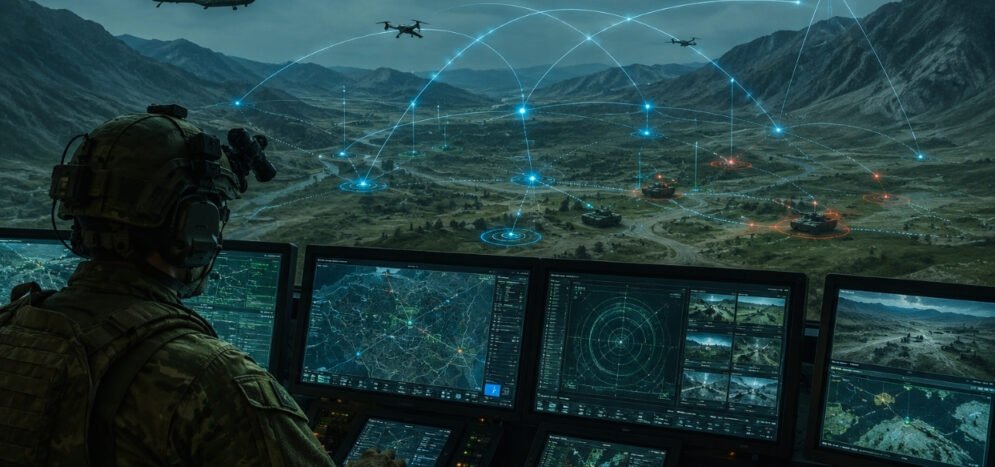
Situational awareness technology has become a critical part of modern defense operations. Military forces operate in increasingly complex environments where threats can emerge from the air, land, sea, space, and cyberspace. Commanders and soldiers must process large amounts of information and make decisions quickly. Situational awareness technology helps address this challenge by collecting, analyzing, and distributing information about the operational environment.
In defense, situational awareness refers to the ability to understand what is happening, identify potential threats, and anticipate possible developments. Modern systems combine data from sensors, radar, satellites, unmanned platforms, communication networks, and intelligence sources to create a clearer operational picture.
As militaries adopt artificial intelligence, autonomous systems, advanced sensors, and network-centric warfare concepts, situational awareness technology is becoming increasingly important for improving decision-making, mission effectiveness, and force protection.
Understanding Situational Awareness in Defense
Situational awareness provides military personnel with real-time or near-real-time information about friendly forces, enemy activity, terrain, weather conditions, and other operational factors.
Traditionally, commanders depended heavily on reports from personnel in the field, reconnaissance units, maps, and intelligence sources. Although these methods remain important, modern warfare generates information at a much faster rate. Advanced technologies now allow defense organizations to collect data from multiple platforms simultaneously.
A modern situational awareness system can combine information from ground sensors, surveillance aircraft, satellites, naval platforms, unmanned aerial vehicles, and command centers. The collected information is then processed and presented through digital displays, command-and-control systems, or portable devices.
The objective is to provide the right information to the right personnel at the right time.
Key Components of Situational Awareness Technology
Situational awareness technology depends on several interconnected systems that work together to create a complete picture of the battlefield.
Sensors and Surveillance Systems
Sensors are among the most important elements of situational awareness. Military forces use radar, electro-optical and infrared sensors, sonar, electronic intelligence systems, and ground surveillance equipment to detect and monitor potential threats.
Radar systems can identify aircraft, missiles, vehicles, and other moving objects. Electro-optical and infrared sensors provide visual and thermal information, while sonar systems support underwater surveillance.
These technologies allow defense forces to monitor large operational areas and detect threats that may not be visible to personnel on the ground.
Communication Networks
Information is only useful when it can be delivered quickly to the personnel who need it. Secure communication networks connect sensors, military platforms, command centers, and deployed forces.
Advanced tactical communication systems increasingly use software-defined radios, satellite communications, secure data links, and mobile networks. The integration of technologies such as 5G and satellite connectivity could further improve communications in future military operations.
Reliable communications are especially important in contested environments where conventional networks may be disrupted.
Command and Control Systems
Command-and-control systems process information from different sources and present it in an understandable format. These platforms can display the location of friendly forces, detected threats, mission areas, and other operational information.
A common operating picture enables commanders at different levels to access shared information. This can improve coordination between land, air, naval, and joint forces.
Modern command-and-control systems are also becoming more mobile, allowing personnel to access operational information through vehicle-mounted systems, portable computers, and secure handheld devices.
Role of Artificial Intelligence
Artificial intelligence is expected to play an increasingly important role in situational awareness technology. Modern military sensors can generate enormous amounts of data, making it difficult for human operators to analyze every piece of information quickly.
AI tools can help process sensor data, identify patterns, detect anomalies, and prioritize potential threats. For example, an AI-enabled system may assist operators in identifying unusual vehicle movements, tracking multiple aerial targets, or analyzing imagery collected by unmanned platforms.
Machine learning can also support predictive analysis. By examining historical and real-time data, AI systems may help identify potential developments and provide decision-support recommendations.
However, human oversight remains essential. Military commanders must verify information and make final decisions, particularly in complex and high-risk situations.
Situational Awareness Across Military Domains
Situational awareness technology is increasingly designed for operations across multiple domains.
On land, soldiers and commanders use battlefield management systems, vehicle sensors, wearable equipment, and unmanned systems to monitor the operational environment. These technologies can improve coordination and reduce the risk of friendly-fire incidents.
In the air domain, situational awareness depends heavily on radar, airborne early warning systems, electronic warfare platforms, satellites, and networked aircraft. Pilots can receive information about potential threats and friendly forces through integrated cockpit displays.
Naval forces use radar, sonar, satellite communications, electronic surveillance systems, and combat management systems to monitor surface, air, and underwater activity.
Space-based assets also play a growing role. Satellites can provide communications, navigation, surveillance, and intelligence data to military forces operating across large geographical areas.
Together, these capabilities support the development of multi-domain situational awareness.
Integration With Unmanned Systems
Unmanned aerial vehicles, ground robots, and autonomous maritime platforms are expanding the amount of information available to military forces.
Drones equipped with cameras, infrared sensors, radar, or electronic intelligence payloads can collect information in areas that may be difficult or dangerous for personnel to access. Ground-based robotic systems can also support surveillance and reconnaissance missions.
The growing use of unmanned systems creates opportunities for persistent monitoring. Instead of relying only on crewed platforms, military forces can deploy multiple sensors across the battlefield.
However, this also increases the challenge of managing large volumes of information. Effective situational awareness requires advanced data processing and secure networks to ensure that useful intelligence reaches decision-makers quickly.
Improving Soldier Situational Awareness
Situational awareness technology is not limited to major command centers. Individual soldiers are increasingly receiving access to digital tools that provide maps, navigation data, mission information, and the locations of friendly units.
Helmet-mounted displays, augmented reality systems, wearable sensors, and portable computing devices could further enhance the information available to personnel in the field.
For example, augmented reality technology may eventually allow soldiers to view navigation routes, identified threats, or operational information directly through a display system.
Such technologies could reduce the time required to interpret battlefield information. They may also improve coordination between dismounted soldiers, vehicles, and command centers.
Challenges Affecting Situational Awareness Systems
Despite their advantages, situational awareness technologies face several challenges.
One major issue is information overload. Modern sensors can produce more data than operators can reasonably process. Without effective filtering and prioritization, excessive information may slow decision-making rather than improve it.
Cybersecurity is another significant concern. Situational awareness systems depend heavily on digital networks and data exchange. Cyberattacks could disrupt communications, manipulate information, or compromise sensitive operational data.
Electronic warfare also presents a challenge. Adversaries may attempt to jam communications, interfere with satellite signals, or deceive sensors.
Interoperability is equally important. Modern military operations often involve different services, allied nations, and multiple technology providers. Systems must be capable of exchanging information securely and efficiently.
Future Outlook
The future of defense situational awareness will likely focus on greater connectivity, automation, and multi-domain integration. Artificial intelligence will support faster data analysis, while cloud computing and edge processing could improve the speed at which information is delivered to deployed forces.
The expansion of satellite constellations, advanced 5G networks, autonomous platforms, and sensor technologies may also create more resilient information networks.
Future military systems are expected to move toward a highly connected environment in which data from aircraft, ships, ground vehicles, satellites, drones, and individual soldiers can contribute to a shared operational picture.
The ability to collect information will remain important, but the ability to process, verify, prioritize, and distribute that information quickly may become an even greater competitive advantage.
Conclusion
Situational awareness technology has become a fundamental capability for modern defense forces. It combines sensors, communications, command-and-control systems, artificial intelligence, and unmanned platforms to provide a clearer understanding of the operational environment.
As warfare becomes increasingly complex, military organizations will require faster and more reliable access to information. Advanced situational awareness systems can help commanders and personnel detect threats, coordinate forces, and make informed decisions.
The continued integration of AI, autonomous systems, secure communications, advanced sensors, and multi-domain networks is expected to shape the next generation of defense situational awareness. While challenges such as cybersecurity, electronic warfare, interoperability, and information overload remain, the technology will continue to play a central role in improving military readiness and operational effectiveness.