

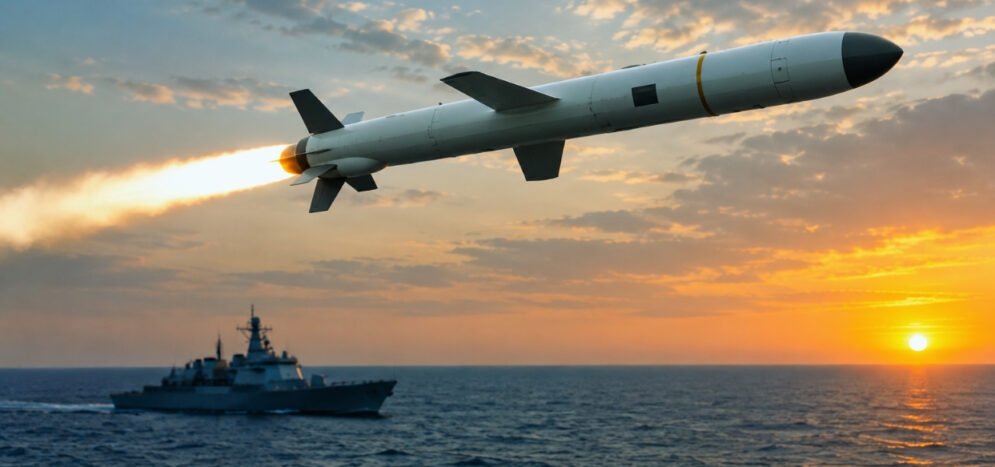
Cruise missile technology has become an important element of modern military capabilities, providing armed forces with a means of delivering precision effects against targets from significant distances. Unlike ballistic missiles, which follow a predominantly high-arc trajectory, cruise missiles generally travel through the atmosphere for most of their flight and use aerodynamic lift and onboard propulsion to maintain controlled flight.
Advances in navigation, propulsion, sensors, materials, communications, and computing have transformed cruise missiles from relatively basic guided weapons into sophisticated systems capable of operating across complex environments. Their ability to combine precision, range, low-altitude flight, and flexible launch options has made them an important component of modern long-range strike architectures.
Evolution of Cruise Missile Technology
The development of cruise missile technology can be traced to early guided weapons that emerged during the 20th century. Early systems relied on comparatively simple guidance mechanisms and had significant limitations in accuracy and reliability. Improvements in electronics, propulsion, and navigation gradually enabled more sophisticated designs.
The introduction of inertial navigation systems represented a major technological step. These systems allowed missiles to estimate their position during flight without requiring continuous external guidance. Later, satellite navigation and terrain-referenced technologies further improved accuracy and enabled more sophisticated flight planning.
Digital computing also transformed cruise missile development. Smaller and more powerful processors allowed onboard systems to process navigation information, manage flight controls, and integrate multiple sensors. At the same time, improvements in materials and manufacturing enabled designers to create lighter, stronger, and more aerodynamically efficient missile structures.
Modern cruise missiles increasingly incorporate networked capabilities and advanced mission planning. These developments allow military planners to integrate missiles into broader intelligence, surveillance, reconnaissance, targeting, and command-and-control networks.
Key Technologies Behind Modern Cruise Missiles
A modern cruise missile consists of multiple interconnected technologies working together to maintain flight and guide the weapon toward its designated target. One of the most important elements is the propulsion system. Many cruise missiles use compact air-breathing engines that provide sustained thrust throughout much of the flight. Improvements in engine efficiency can contribute to increased range, reliability, and operational flexibility.
Guidance and navigation technologies are equally important. Inertial navigation provides continuous position estimation, while satellite navigation can support additional accuracy where available. Some advanced systems can combine multiple navigation techniques to maintain performance when one source of information becomes unreliable.
Terrain-referenced navigation and digital mapping technologies can support flight planning through complicated geographical environments. Radar or electro-optical sensors may also contribute to terminal guidance in certain missile designs. The combination of navigation and sensing technologies allows modern systems to maintain controlled flight over long distances.
Flight-control systems are responsible for maintaining the missile’s trajectory. Sensors continuously provide information about movement and orientation, while onboard computers use this data to control aerodynamic surfaces and propulsion systems. These capabilities allow cruise missiles to follow planned flight paths and respond to changing conditions.
The missile’s airframe is another important area of technological development. Engineers increasingly use lightweight alloys, composites, and other advanced materials to balance structural strength, aerodynamic performance, thermal requirements, and weight. Aerodynamic design can also contribute to improved efficiency during sustained atmospheric flight.
Precision, Survivability, and Operational Flexibility
One of the defining characteristics of modern cruise missile technology is the emphasis on precision. Improvements in navigation, onboard computing, sensors, and mission planning have enabled increasingly accurate delivery of military effects.
Survivability is another major design consideration. Cruise missiles generally operate within the atmosphere and can be designed to use flight profiles that make detection and interception more challenging. Their effectiveness therefore depends not only on range and accuracy but also on their ability to operate within increasingly sophisticated air-defense environments.
Electronic technologies are becoming increasingly relevant to missile survivability. Modern military systems operate in environments where radar detection, electronic warfare, communications disruption, and countermeasures can influence mission effectiveness. As a result, missile developers continue to focus on navigation resilience, sensor integration, and system-level survivability.
Launch flexibility is also an important feature. Depending on the system, cruise missiles can be deployed from land-based platforms, surface ships, submarines, or aircraft. This variety of launch platforms allows armed forces to integrate cruise missiles into different operational concepts.
Role of Sensors, Artificial Intelligence, and Digital Systems
The increasing availability of advanced sensors and digital processing is influencing the future direction of cruise missile technology. Modern onboard computing systems can process navigation and sensor information rapidly while supporting sophisticated mission-management functions.
Artificial intelligence and machine learning are being explored across the wider defense sector for applications such as target recognition, sensor processing, route optimization, and decision support. In cruise missile development, these technologies could potentially support more adaptive systems capable of responding to complex operational environments.
However, autonomous capabilities also introduce technical, legal, ethical, and operational considerations. Reliable identification and classification of objects, resistance to misleading information, and appropriate human oversight remain important issues as military organizations explore increasingly automated weapon technologies.
Digital engineering is also changing how cruise missiles are designed and tested. Digital twins, simulation environments, model-based systems engineering, and advanced computational tools can allow engineers to evaluate designs before physical prototypes are produced. These methods can shorten development cycles and identify engineering challenges earlier.
Applications Across Modern Defense Forces
Cruise missiles are integrated into a variety of military missions, particularly long-range precision-strike roles. Naval forces can use ship- and submarine-launched systems as part of maritime strike and land-attack capabilities. Aircraft can provide additional flexibility by launching missiles from airborne platforms, potentially extending operational reach.
Land forces can also employ ground-launched cruise missile systems as part of long-range fires architectures. Such systems may complement artillery, tactical missiles, and other precision-strike capabilities.
Cruise missiles can also contribute to deterrence strategies. Their combination of range, precision, and platform diversity can provide military planners with additional options for responding to emerging security scenarios.
The development of cruise missile capabilities is consequently linked to broader trends in integrated warfare. Intelligence networks, satellites, unmanned systems, surveillance platforms, electronic warfare systems, and command-and-control infrastructure can all influence how long-range precision weapons are employed within a larger military architecture.
Market Growth and Technological Trends
The global cruise missile technology market is influenced by modernization programs, geopolitical developments, advances in precision-strike capabilities, and demand for sophisticated defense systems. Countries are investing in new systems and upgrades as they seek to enhance long-range strike capabilities and integrate them with modern military networks.
Several technological trends are expected to shape the sector. Advanced propulsion systems could improve efficiency and range, while compact electronics can enable greater processing capability within smaller packages. Improved sensors and navigation technologies may support more resilient precision performance.
Hypersonic weapons are also changing the broader long-range strike environment. Although hypersonic weapons differ significantly from conventional cruise missiles in propulsion and flight characteristics, their development is encouraging greater attention to speed, maneuverability, survivability, and advanced materials.
Counter-cruise-missile capabilities are developing in parallel. As missile technologies improve, air-defense organizations are investing in advanced radars, interceptor missiles, electronic warfare, directed-energy technologies, and integrated command-and-control systems. This creates an ongoing cycle of development between offensive missile capabilities and defensive technologies.
Challenges and Future Outlook
Despite significant technological progress, cruise missile development presents several challenges. Achieving greater range, precision, survivability, and affordability simultaneously can require complex engineering trade-offs. Propulsion efficiency, thermal management, navigation reliability, sensor performance, and manufacturing costs must be balanced during system development.
The growing sophistication of air-defense networks is another major challenge. Modern integrated air-defense systems can combine multiple sensors and interceptors, requiring missile developers to continuously improve system resilience and overall survivability.
Supply-chain security is also becoming increasingly important. Advanced cruise missiles rely on specialized electronics, sensors, propulsion components, materials, and manufacturing capabilities. Maintaining secure access to these technologies is therefore an important consideration for defense industries.
Looking ahead, cruise missile technology is expected to become more connected, digitally engineered, sensor-rich, and adaptable. Advances in artificial intelligence, propulsion, materials science, navigation, electronics, and manufacturing could contribute to increasingly sophisticated systems.
Conclusion
Cruise missile technology has evolved from relatively simple guided weapons into a sophisticated field combining aerospace engineering, propulsion, navigation, sensors, computing, materials science, and systems integration. Their ability to deliver precision effects over long distances has made cruise missiles an important component of modern military capabilities.
Future development will increasingly focus on improving navigation resilience, propulsion efficiency, sensor integration, survivability, digital engineering, and interoperability with broader defense networks. At the same time, the rapid development of air-defense and counter-missile technologies will continue to influence the evolution of the sector.
As defense forces modernize their long-range capabilities, cruise missile technology is likely to remain an important area of research, investment, and industrial development. Its future will be shaped not by a single technological breakthrough, but by the convergence of multiple advances across aerospace, electronics, computing, propulsion, and advanced manufacturing.