

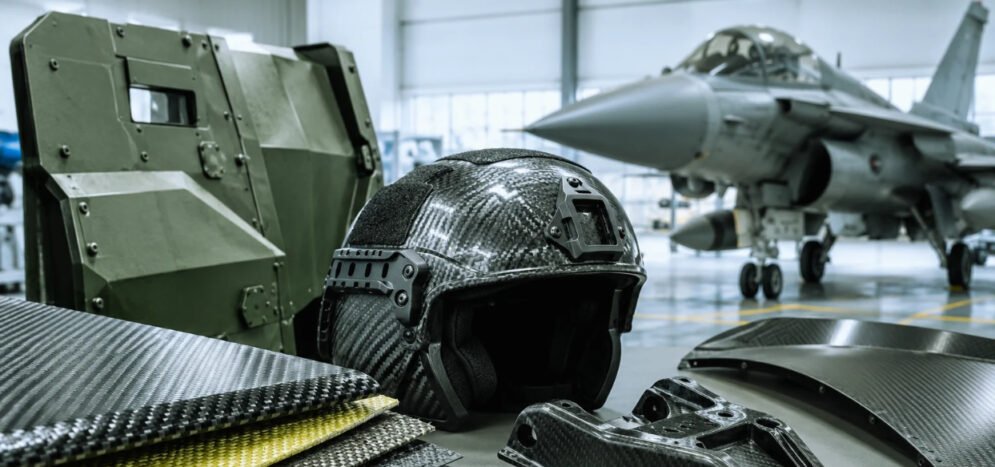
Defense composites technology is becoming an important part of modern military engineering, enabling the development of lighter, stronger and more durable platforms across aerospace, naval, land and missile systems. As armed forces seek greater operational efficiency, improved protection and enhanced mobility, composite materials are increasingly being used as alternatives to conventional metals in selected structural and protective applications.
Composite materials are engineered by combining two or more constituent materials to achieve properties that are difficult to obtain from a single material. In defense applications, these commonly include carbon-fibre-reinforced polymers, glass-fibre composites, aramid-fibre composites and ceramic-matrix composites. Each material offers different combinations of strength, stiffness, weight, thermal resistance and impact performance, making material selection dependent on the platform’s mission and operating environment.
The growing adoption of composites reflects a broader shift towards advanced materials that can improve platform performance while reducing lifecycle costs. From aircraft structures and naval superstructures to protective equipment and missile components, defense composites are supporting innovation across the military supply chain.
Key Applications of Defense Composites Technology
Aerospace is one of the most important application areas for defense composites. Military aircraft require structural materials that provide high strength with minimal weight, as lower structural mass can improve payload capacity, fuel efficiency and flight performance. Carbon-fibre composites are used in selected fuselage sections, wings, control surfaces, fairings and other structural components of modern aircraft. Their high stiffness-to-weight ratio also helps engineers optimise aerodynamic structures and reduce fatigue-related maintenance in suitable applications.
Composites are particularly relevant to unmanned aerial vehicles (UAVs), where weight reduction can contribute to longer endurance, greater payload flexibility and improved mission range. Lightweight composite airframes can also support compact designs for tactical drones and loitering platforms. In advanced combat aircraft, specialised composite structures may contribute to radar-signature management when incorporated into an appropriately designed system. However, low observability depends on the complete aircraft design, coatings, geometry and management of electromagnetic signatures, rather than on composite materials alone.
Naval defense is another significant market for composite materials. Ships and submarines operate in corrosive environments where saltwater, moisture and demanding maintenance conditions can affect conventional structures. Fibre-reinforced composites offer corrosion resistance and can reduce maintenance requirements in suitable applications. They are used in selected naval superstructures, radomes, masts, enclosures, small boats and mine-countermeasure systems.
Composite materials can also provide advantages in mine warfare because some designs can reduce magnetic signatures and support the development of specialised lightweight structures. Their suitability depends on structural loads, fire performance, impact resistance and the specific requirements of the vessel. In submarine and underwater applications, material selection must account for pressure, fatigue, water absorption and long-term reliability.
Land-based defense systems use composites in vehicle armour, personnel protection, equipment housings and selected structural components. Aramid fibres, ultra-high-molecular-weight polyethylene and ceramic-based composite systems can contribute to protective solutions designed to resist specific ballistic or fragmentation threats. Multilayer armour may combine ceramics, fibres, metals and other materials to balance protection, weight and durability.
Reducing vehicle weight is particularly important for armoured platforms because it can support mobility, payload capacity and fuel efficiency. However, composite armour must be designed and tested against defined threat profiles, including projectile impact, environmental exposure and repeated operational stresses. Lightweight materials are not automatically equivalent to higher protection; performance depends on the complete armour configuration and its validation.
Missile and space-related defense systems also benefit from advanced composites. Composite motor casings, structural components, protective fairings and radomes can offer weight savings and specialised mechanical or thermal properties. High-temperature composites and ceramic-matrix materials are relevant to demanding thermal environments, although their use requires sophisticated manufacturing processes and extensive qualification. In radomes, material properties must be carefully controlled to maintain the transmission characteristics required by radar and communications systems.
Market Drivers, Manufacturing Challenges and Emerging Technologies
The defense composites market is being influenced by rising demand for advanced aircraft, next-generation combat vehicles, unmanned systems, naval modernisation and precision-guided weapons. Military programmes increasingly prioritise weight optimisation, durability and improved performance under demanding operating conditions. These requirements are encouraging defense manufacturers to invest in material research, composite fabrication and advanced testing capabilities.
The growth of unmanned and autonomous platforms is another important driver. UAVs, unmanned surface vessels and unmanned underwater vehicles often require compact structures that maximise payload capacity and endurance. Composite materials can help meet these requirements while providing design flexibility for integrating sensors, communication equipment and mission-specific payloads.
However, adopting composites across defense platforms presents several challenges. Manufacturing costs can be high, particularly for advanced carbon fibres, specialised resins, ceramic-matrix materials and aerospace-grade components. Production also requires precise control over fibre orientation, resin distribution, curing temperatures and material consistency. Defects such as voids, delamination and incomplete curing can affect structural integrity and component reliability.
Quality assurance is especially important because composite structures may experience internal damage that is not immediately visible. Non-destructive testing methods, including ultrasonic inspection, thermography and computed tomography, help manufacturers identify defects without damaging components. Digital manufacturing records and automated inspection systems are also becoming important for maintaining traceability and repeatable production quality.
Repair and lifecycle management create additional challenges. Unlike conventional metal structures, composite components may require specialised repair procedures, trained personnel and specific environmental controls. Military operators must also evaluate how materials perform under prolonged exposure to ultraviolet radiation, moisture, temperature variations, chemicals and repeated mechanical loading.
Supply-chain security is another consideration. Access to high-performance fibres, specialised resins, manufacturing equipment and testing infrastructure can affect production schedules and costs. Countries seeking greater defense-industrial independence are therefore investing in domestic material research, supplier development and indigenous manufacturing capabilities.
Emerging technologies are expected to expand the role of composites in future military systems. Automated fibre placement, robotic composite manufacturing and additive manufacturing of selected tooling and components can improve production efficiency and design flexibility. Researchers are also developing multifunctional composites that combine structural performance with sensing, electromagnetic or thermal-management capabilities.
Thermoplastic composites are attracting interest because some offer faster processing, improved impact resistance and the potential for more efficient repair or recycling than certain conventional thermoset systems. Meanwhile, advanced ceramic-matrix composites are being investigated for applications requiring resistance to extreme temperatures. The suitability of these materials depends on component design, operating conditions, production economics and qualification requirements.
Artificial intelligence and digital engineering may further improve composite manufacturing. Digital twins, process simulations and predictive maintenance tools can help manufacturers monitor production quality, assess structural behaviour and plan repairs. For defense applications, these technologies could support more consistent manufacturing and improve the management of complex component lifecycles.
Future Outlook for Defense Composites Technology
The future of defense composites technology will depend on the ability to combine material innovation with reliable, scalable and cost-effective manufacturing. As military platforms become more advanced, defense original equipment manufacturers (OEMs), material suppliers, research institutions and government laboratories are likely to place greater emphasis on developing composites tailored to specific operational requirements.
India presents opportunities in this field through its expanding aerospace and defense manufacturing ecosystem. Indigenous aircraft programmes, UAV development, naval modernisation and advanced missile projects can create demand for locally manufactured composite structures and specialised materials. Building domestic capabilities in carbon-fibre production, resin systems, precision fabrication, non-destructive testing and certification could strengthen the local supply chain and reduce dependence on imported technologies.
Collaboration between public research organisations, private manufacturers and academic institutions will be important for translating laboratory advances into qualified defense products. Companies that can demonstrate consistent quality, meet demanding certification standards and scale production efficiently may be well positioned to participate in domestic and international defense supply chains.
Nevertheless, composites will not replace metals across every defense application. Aluminium alloys, titanium, steel and other established materials will continue to serve important roles where their cost, thermal properties, toughness or manufacturing characteristics offer advantages. Future platforms are therefore likely to use hybrid material architectures that combine composites and metals according to specific engineering requirements.
Overall, defense composites technology is evolving from a specialised materials capability into a strategic component of military platform design. Its contribution extends beyond weight reduction to include corrosion resistance, structural optimisation, specialised protection and greater design flexibility. As manufacturing methods mature and material performance improves, composites are expected to remain central to the development of next-generation defense systems, creating opportunities for innovation, industrial growth and more capable military platforms.