

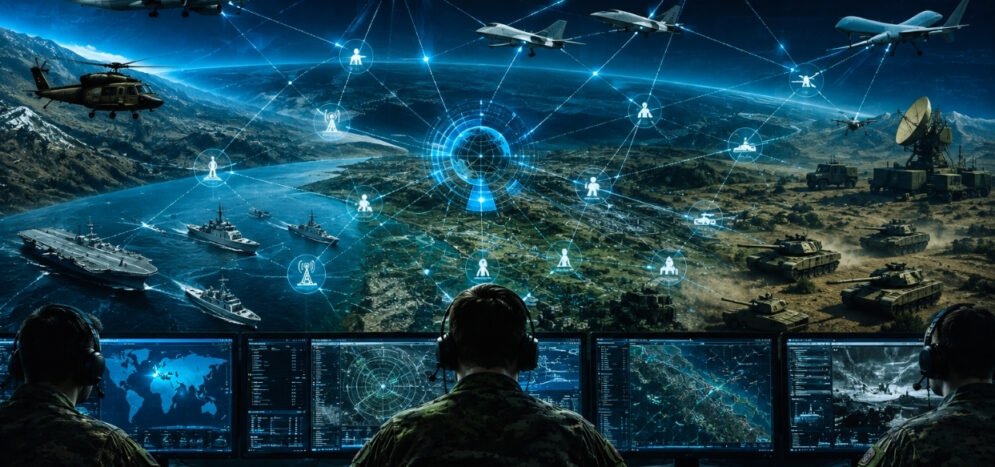
C4ISR technology has become a critical element of modern defense operations. The term C4ISR stands for Command, Control, Communications, Computers, Intelligence, Surveillance, and Reconnaissance. It combines advanced technologies, networks, sensors, software, and communication systems to provide military forces with accurate information and improve decision-making.
Modern warfare is increasingly driven by information. Military commanders need to understand the battlefield, identify potential threats, communicate with different units, and respond quickly to changing situations. C4ISR technology helps connect these activities through an integrated information and decision-support environment.
The growing use of unmanned systems, artificial intelligence, satellite communications, electronic warfare, and advanced sensors is further increasing the importance of C4ISR technology in the defense industry.
What Is C4ISR Technology?
C4ISR refers to an integrated military capability that connects command systems with communication networks, computing infrastructure, intelligence platforms, surveillance systems, and reconnaissance assets.
The main objective of C4ISR is to provide the right information to the right personnel at the right time. This helps military organizations develop better situational awareness and coordinate operations across land, air, sea, space, and cyber domains.
A modern C4ISR network may connect command centers, soldiers, military vehicles, aircraft, naval vessels, satellites, drones, radar systems, and intelligence platforms. These connected systems can collect, process, share, and analyze information across the defense network.
Command and Control
Command and control forms the operational foundation of C4ISR technology. Military commanders require reliable systems to plan missions, allocate resources, monitor operations, and issue instructions.
Digital command-and-control systems allow information from multiple sources to be displayed through integrated operational interfaces. Commanders can monitor friendly forces, identify potential threats, and respond to changing battlefield conditions.
Advanced command systems are increasingly designed to support joint and multinational operations. This requires interoperability between different military branches and, in some cases, allied forces.
Communications and Network Connectivity
Reliable communication is essential for effective military operations. C4ISR systems use secure communication networks to connect personnel and platforms operating across large geographical areas.
Military communications can include tactical radios, satellite communications, secure data links, fiber networks, and wireless systems. These technologies allow information to move between command centers and deployed forces.
Modern defense organizations are also focusing on resilient communications. Military networks must continue operating even when facing electronic warfare, cyberattacks, physical damage, or communication disruptions.
Mesh networks, satellite connectivity, software-defined radios, and alternative communication pathways are becoming increasingly important in improving network resilience.
Computers and Data Processing
C4ISR systems generate significant amounts of data from sensors, surveillance platforms, intelligence sources, and military units. Advanced computing infrastructure is required to process this information quickly.
High-performance computing, cloud technologies, edge computing, and advanced software are increasingly being integrated into defense networks.
Edge computing is particularly important because it allows data to be processed closer to where it is collected. A drone, military vehicle, or deployed sensor can analyze certain information locally instead of sending all data to a distant command center.
This can reduce communication requirements and improve response times during time-sensitive operations.
Intelligence, Surveillance, and Reconnaissance
Intelligence, surveillance, and reconnaissance capabilities provide the information that supports military decision-making.
Intelligence can come from multiple sources, including satellite imagery, radar systems, signals intelligence, electronic intelligence, human intelligence, and open-source information.
Surveillance systems continuously monitor specific locations, regions, or activities. Reconnaissance platforms gather detailed information about potential threats and operational environments.
Modern C4ISR technology combines information from multiple sensors and platforms. This process, often referred to as sensor fusion, can provide a more complete operational picture.
For example, data from satellites, drones, radar systems, and ground sensors can be integrated into a single command-and-control environment.
Importance of C4ISR in Modern Warfare
The importance of C4ISR technology is growing because modern military operations require faster and more accurate decision-making.
Traditional military operations often involved separate systems and slower information-sharing processes. Modern C4ISR networks aim to connect sensors, commanders, and operational units more efficiently.
Improved situational awareness can help commanders understand the location of friendly forces, identify potential threats, monitor operational developments, and coordinate responses.
C4ISR technology also supports joint operations. Land forces, air forces, naval forces, space assets, and cyber units can share information through connected networks.
This capability is becoming increasingly important as defense organizations move toward multi-domain operations.
Technological Advancements Driving C4ISR Development
Several emerging technologies are transforming C4ISR capabilities.
Artificial intelligence and machine learning can help process large volumes of data and identify important patterns. AI-enabled systems may assist analysts by prioritizing information, detecting anomalies, and supporting faster decision-making.
Autonomous systems are also expanding the C4ISR ecosystem. Unmanned aerial vehicles, unmanned ground vehicles, and autonomous maritime platforms can collect intelligence and transmit information to command networks.
Satellite technology is another major area of development. Military and commercial satellite constellations can provide communication, navigation, surveillance, and intelligence capabilities across large areas.
Advanced sensors, including electro-optical, infrared, radar, and signals intelligence systems, are also improving the amount and quality of data available to military forces.
Growing Integration of AI and Autonomous Systems
Artificial intelligence is expected to play an increasingly important role in future C4ISR systems. Military organizations are dealing with growing volumes of information that can be difficult for human operators to analyze quickly.
AI-based software can support data fusion and assist in identifying relevant information. Machine learning algorithms can also improve the analysis of imagery and sensor data.
Autonomous platforms can extend the reach of surveillance and reconnaissance operations. Drones can collect intelligence in areas that may be difficult or dangerous for personnel to access.
However, human oversight remains important. Military organizations must ensure that automated systems provide reliable information and that commanders retain appropriate control over critical decisions.
Cybersecurity and Electronic Warfare Challenges
As military systems become increasingly connected, cybersecurity becomes a major requirement.
C4ISR networks may become targets for cyberattacks designed to disrupt communications, access sensitive information, or interfere with military operations. Defense organizations are therefore investing in encryption, network protection, zero-trust approaches, cyber monitoring, and resilient system architectures.
Electronic warfare also presents a significant challenge. Adversaries may attempt to jam communication signals, interfere with navigation systems, or disrupt sensor networks.
Future C4ISR systems will require the ability to detect disruptions and maintain operations through alternative communication and information pathways.
Increasing Demand for Integrated Defense Networks
Defense forces are increasingly moving away from isolated platforms and toward connected operational networks.
A fighter aircraft, naval vessel, ground vehicle, drone, radar system, and command center can generate valuable information. The challenge is to securely integrate these different sources.
This is driving demand for open architectures, interoperable systems, standardized interfaces, and advanced data-sharing technologies.
The ability to connect legacy military equipment with new digital platforms is also becoming an important requirement. Many armed forces operate equipment that may remain in service for decades, creating demand for modernization and integration solutions.
Regional Developments in the C4ISR Market
North America remains a major center for C4ISR development due to significant defense investment and the presence of major aerospace, defense, software, and technology companies.
Europe is also investing in integrated defense networks, secure communications, intelligence capabilities, and multinational interoperability.
The Asia-Pacific region is witnessing growing investment in military modernization. Countries are developing advanced surveillance networks, satellite systems, secure communications, drones, and digital command-and-control capabilities.
The Middle East is also investing in advanced C4ISR technologies as regional governments strengthen border surveillance, air defense, intelligence, and military communication capabilities.
Competitive Landscape
The C4ISR technology sector includes major defense contractors, communication system providers, radar and sensor manufacturers, software companies, satellite operators, and emerging technology firms.
Competition is increasingly focused on system integration, cybersecurity, artificial intelligence, autonomous technologies, and interoperability.
Companies that can connect multiple platforms and sensors into secure and effective information networks are likely to play an important role in the future C4ISR market.
Partnerships between defense companies and commercial technology providers are also expected to increase as military organizations adopt advanced cloud computing, AI, communications, and data-processing technologies.
Challenges Affecting C4ISR Technology Growth
Despite its importance, C4ISR development faces several challenges. Interoperability remains a major issue because military forces often operate equipment from different manufacturers and generations.
Cybersecurity risks are also increasing as defense networks become more connected.
Managing large volumes of data presents another challenge. Collecting information is not enough; military organizations must be able to process and distribute relevant intelligence quickly.
Cost is another important factor. Developing secure communication networks, advanced sensors, satellite capabilities, and integrated command systems requires significant investment.
Maintaining these systems over long operational lifecycles can also increase defense budgets.
Future Outlook of C4ISR Technology
The future of C4ISR technology will be shaped by greater connectivity, automation, artificial intelligence, and multi-domain integration.
Future systems are expected to connect a growing number of platforms, including satellites, drones, autonomous vehicles, aircraft, naval vessels, ground systems, and individual soldiers.
AI will likely improve sensor fusion, data analysis, and decision support. Edge computing will enable faster processing closer to operational environments, while resilient communication networks will help maintain connectivity during contested operations.
The development of integrated systems across land, air, sea, space, and cyber domains will continue to drive investment in C4ISR technologies.
Conclusion
C4ISR technology has become a fundamental capability for modern defense forces. By integrating command, control, communications, computers, intelligence, surveillance, and reconnaissance, it helps military organizations improve situational awareness and coordinate complex operations.
The rapid growth of artificial intelligence, autonomous systems, advanced sensors, satellite communications, cloud computing, and cybersecurity is transforming the C4ISR landscape.
As future warfare becomes increasingly information-driven and multi-domain, demand for advanced, resilient, and interoperable C4ISR systems is expected to grow. The ability to collect, process, protect, and distribute information quickly will remain a key factor in shaping the effectiveness of modern military operations.