
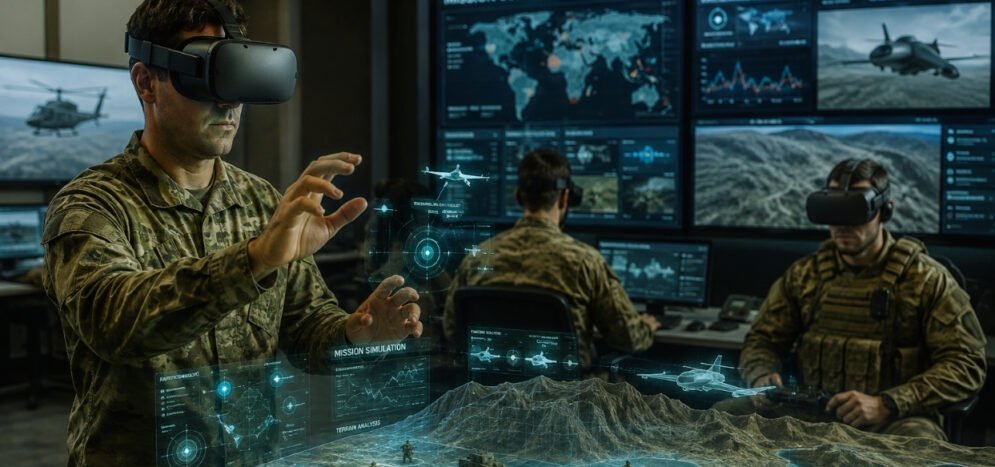
AR & VR Defense Technology are emerging as important technologies in the modernization of defense forces. By combining immersive digital environments, real-time data visualization, simulation, and advanced training tools, AR & VR Defense Technology is changing how military personnel train, operate, maintain equipment, and prepare for complex battlefield situations.
Traditional military training often requires expensive equipment, dedicated training areas, physical platforms, and significant logistical support. AR & VR Defense Technology can complement these methods by creating realistic and repeatable environments where soldiers, pilots, sailors, and maintenance personnel can practice tasks with reduced dependence on physical assets. As defense organizations increasingly adopt digital transformation, immersive technologies are becoming part of broader military training and operational ecosystems.
Role of AR and VR in Defense
AR and VR serve different but complementary purposes in military applications. VR creates a fully simulated environment in which users can interact with virtual battlefields, vehicles, aircraft, weapons systems, or command scenarios. AR, meanwhile, overlays digital information onto the user’s real-world surroundings through specialized displays, headsets, or other wearable systems.
AR & VR Defense Technology distinction makes the technologies useful across different defense activities. VR is particularly valuable for training and simulation, while AR can support field operations, maintenance, navigation, situational awareness, and decision-making.
Modern systems can also connect immersive environments with artificial intelligence, sensors, digital twins, geographic information systems, and command-and-control networks. This integration can provide personnel with a more comprehensive understanding of operational environments.
Military Training and Simulation
Training remains one of the most significant applications of AR & VR Defense Technology. Military organizations need personnel to be prepared for situations that may be dangerous, expensive, or difficult to reproduce in real life. Immersive simulation can address some of these challenges.
VR-based systems can recreate aircraft cockpits, armored vehicles, naval environments, urban battlefields, and other operational scenarios. Personnel can practice procedures repeatedly while instructors monitor their performance. Training scenarios can also be modified to introduce different levels of complexity, environmental conditions, and operational challenges.
For pilots, VR and mixed-reality systems can supplement conventional flight simulators by providing immersive environments for emergency procedures and mission preparation. Similarly, ground forces can use virtual environments to practice tactical coordination and equipment operation without continuously deploying physical platforms.
AR can provide another layer of training by combining real equipment with digital instructions, allowing trainees to see virtual indicators, guidance information, or system components while interacting with physical hardware.
Enhanced Battlefield Situational Awareness
AR has considerable potential for improving battlefield situational awareness. Military personnel operating in complex environments may need to process information from multiple sensors and communication systems. Presenting all this information through conventional displays can increase cognitive workload.
AR-enabled systems can place relevant digital information within the user’s field of view. Depending on the system and mission, this may include navigation information, maps, friendly-force locations, mission instructions, or equipment status.
When connected to secure military networks, AR systems could help personnel visualize information while remaining focused on their physical surroundings. This capability is particularly relevant for dismounted soldiers, vehicle crews, special operations personnel, and other users who operate in dynamic environments.
Maintenance and Logistics Applications
AR and VR are also changing military maintenance processes. Modern aircraft, ships, armored vehicles, radar systems, and electronic platforms contain increasingly sophisticated components. Maintaining these systems requires highly trained personnel and accurate technical information.
AR can provide technicians with step-by-step digital instructions overlaid on physical equipment. Instead of repeatedly consulting manuals or separate computer terminals, maintenance personnel can access relevant information through a wearable display.
VR can support maintenance training by allowing technicians to practice procedures in a simulated environment before working on operational equipment. This approach can help personnel become familiar with complex systems while reducing the risk of mistakes during training.
Digital twins can further enhance these applications by creating virtual representations of physical platforms and components. When combined with real-time equipment data, digital twins can support training, maintenance planning, diagnostics, and lifecycle management.
Defense Equipment Design and Development
Immersive technologies can also support the design and development of future defense systems. Engineers can use VR environments to visualize vehicles, aircraft interiors, command centers, and equipment layouts before physical prototypes are produced.
Virtual models allow designers to examine ergonomics, accessibility, component placement, and human-machine interaction. This can help identify potential design problems earlier in the development cycle.
AR can similarly assist engineers and technicians during prototype evaluation by displaying digital design information alongside physical components. These capabilities can contribute to shorter development cycles and more efficient collaboration between defense manufacturers, engineers, and military users.
Integration with Artificial Intelligence
The combination of AR, VR, and artificial intelligence is expected to expand the capabilities of immersive defense systems. AI can generate adaptive training scenarios based on an individual’s performance and modify virtual environments in real time.
For example, an AI-enabled training system could evaluate how personnel respond to changing conditions and introduce new challenges accordingly. AI can also support virtual opponents, automated scenario generation, speech interaction, and performance analysis.
In operational environments, AI-supported AR systems could help organize large volumes of sensor and mission data and present the most relevant information to personnel. However, such systems require rigorous testing because inaccurate or delayed information could negatively affect decision-making.
Challenges and Limitations
Despite their potential, AR and VR defense technologies face several challenges. Hardware must be lightweight, durable, secure, and capable of operating in demanding military environments. Headsets and wearable devices also need sufficient battery life for extended missions.
Cybersecurity is another major concern. Connected immersive systems may process sensitive operational, training, or equipment information. Protecting these systems against unauthorized access, data manipulation, and cyberattacks is therefore essential.
Interoperability is also important because defense forces operate a wide range of platforms and communication networks. AR and VR systems need to exchange information effectively with existing command-and-control, simulation, sensor, and training infrastructure.
Future Outlook
The future of AR and VR defense technology is likely to be shaped by greater integration with AI, digital twins, advanced sensors, cloud computing, secure networks, and mixed-reality interfaces. As hardware becomes smaller and more capable, immersive technologies could move beyond dedicated training centers and become increasingly relevant to field operations.
Military organizations are also expected to place greater emphasis on networked simulation, where personnel in different locations can participate in the same virtual training environment. This could support multinational exercises and distributed mission preparation.
Ultimately, AR & VR Defense Technology are not replacements for conventional military systems or live training. Instead, they are becoming complementary technologies that can improve training effectiveness, technical understanding, operational awareness, and preparedness.
Conclusion
AR and VR defense technology is contributing to a new generation of military training and operational capabilities. From immersive simulations and aircraft training to battlefield visualization, maintenance assistance, and equipment design, these technologies can reduce training constraints while providing personnel with realistic digital experiences.
As defense forces continue their digital transformation, the combination of AR, VR, AI, digital twins, and connected defense networks could create increasingly sophisticated military ecosystems. The organizations that successfully integrate these technologies with existing platforms, cybersecurity frameworks, and operational requirements will be better positioned to develop flexible and technology-driven defense capabilities.