

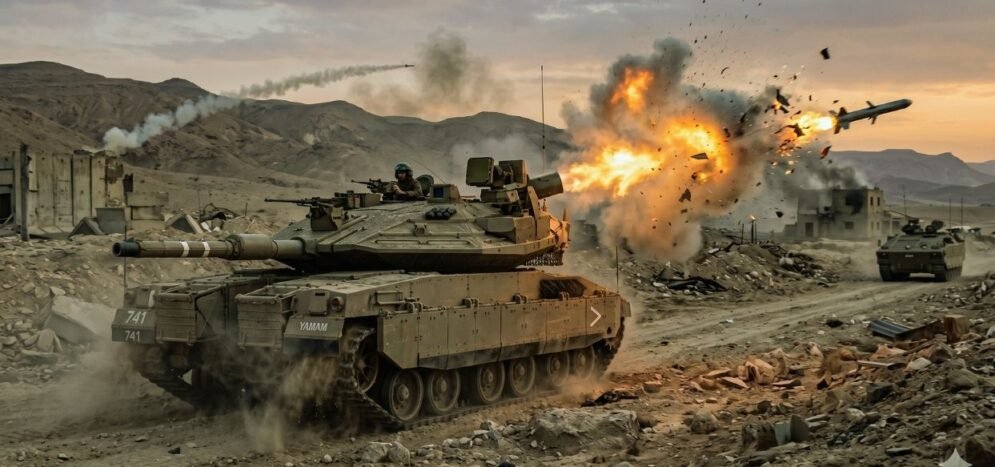
Active Protection Systems: How Modern Tanks Are Fighting Back Against Missiles and Drones
The Problem with Traditional Tank Armor
The Active Protection Systems in tank has always been a strange mix. It offers massive attack power wrapped in heavy steel. However, enemies spend every moment trying to destroy it. For decades, the main solution was simply adding thicker armor. Therefore, tanks just became heavier. Today, that old method no longer works.
Furthermore, cheap weapons are spreading quickly. Infantry forces now use Anti-Tank Guided Missiles (ATGMs) and rocket-propelled grenades (RPGs). They also deploy deadly first-person-view (FPV) drones. As a result, foot soldiers can destroy a ten-million-dollar tank with a five-hundred-dollar weapon.
Passive armor remains very important. Slabs of steel and reactive tiles still save lives. Yet, they are not enough anymore. Enter Active Protection Systems (APS). These clever systems detect and destroy threats before they hit the vehicle. Consequently, APS changes a static shield into a thinking, dynamic defense.
The Mechanics: How APS Actually Works
First, radar or infrared sensors constantly scan the battlefield. They watch closely for anything moving fast. Next, a threat crosses a specific speed limit. At this point, the system quickly locks onto the target.
Then, a smart computer makes a split-second choice. It decides exactly how to intercept the weapon. Amazingly, this entire process happens in just 0.3 seconds.
Afterward, the system fights back. It defends the tank using one of two different methods.
Soft-Kill Protection Systems
Soft-Kill systems defeat threats without physical crashes. Instead, they use smart electronic tricks. For instance, they use laser jammers to break missile guidance links. They also shoot special smoke to blind enemy thermal cameras.
Therefore, Soft-Kill is much lighter. It also carries no risk of hurting friendly troops. However, it cannot stop a basic, unguided rocket like an RPG-7.
Hard-Kill Protection Systems
Meanwhile, Hard-Kill systems physically destroy the incoming weapon. They shoot an explosive countermeasure from the tank. This blast stops the threat safely away from the hull.
As a result, Hard-Kill works against almost everything. It stops both guided and unguided rockets. However, this intercept creates flying metal. Therefore, it poses a major danger to foot soldiers walking near the tank.
Leading APS Models in the Field
Today, several major systems lead the global defense market.
Trophy (Israel)
Trophy is the most combat-proven Active Protection Systems in service today. It uses four radars to see in all directions. Then, it fires a focused blast to destroy the incoming threat. Furthermore, Trophy saw its first combat success in 2011. Since then, it has stopped dozens of rockets in real battles. Consequently, the U.S. Army now puts Trophy on its Abrams tanks.
Iron Fist (Israel)
Iron Fist uses a slightly different approach. It shoots a non-explosive round to break the incoming missile. Therefore, it creates much less flying metal. This makes it much safer for nearby infantry. In addition, its lighter weight makes it perfect for smaller armored vehicles.
Arena-M (Russia)
Russia builds the Arena-M system. It uses a special radar and a ring of explosives. On paper, it looks like a very capable design. However, its real-world performance remains unclear in recent conflicts. Consequently, global buyers are watching its battle results very closely.
Tactical Impact and Real-World Challenges
Active Protection Systems deeply changes how armies fight. Previously, a cheap RPG could easily destroy a costly tank. APS does not completely remove that danger. However, it makes those cheap weapons fail very often. Therefore, enemies must now fire many rockets at once to overwhelm the system.
Still, Active Protection Systems faces real operational problems:
- High Costs: Adding Trophy to one tank costs over $350,000.
- Heavy Weight: Hard-Kill systems add over 1,000 kg. Consequently, this extra weight slows the tank down.
- Power Drain: Radars constantly drain the tank’s electrical battery.
- Danger to Troops: Friendly soldiers must stay far away from the tank to avoid flying metal.
The Future of Tank Protection
The modern battlefield is changing very fast. Small FPV drones are cheap and hard to spot. They fly slowly and confuse current radars. Furthermore, weapons like the Javelin missile attack from directly above. Sadly, most current APS cannot see straight up.
To fix this, engineers are working on new ideas. First, they are using Artificial Intelligence to spot slow drones. Second, they are building better launchers to cover the roof. Finally, they are testing lasers to destroy threats without creating dangerous shrapnel.
In conclusion, tank warfare is entering a new era. Today, smart software matters just as much as thick steel.