
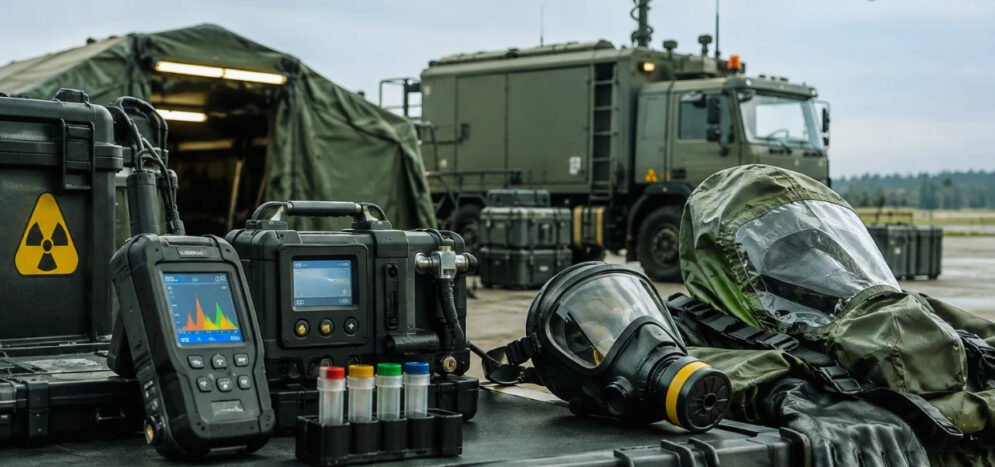
CBRN technology refers to specialized technologies designed to detect, identify, monitor, protect against, and respond to Chemical, Biological, Radiological, and Nuclear (CBRN) hazards. These technologies are critical for military forces, emergency responders, healthcare organizations, border agencies, industrial facilities, and critical infrastructure operators.
CBRN incidents can occur because of industrial accidents, hazardous material releases, deliberate attacks, or contamination events. The consequences can extend across large geographic areas and affect personnel, infrastructure, public health, and essential services. As a result, governments and defense organizations are investing in advanced CBRN detection, protection, decontamination, and emergency-response capabilities.
Technological developments in sensors, artificial intelligence, robotics, communications, materials science, and data analytics are transforming conventional CBRN defense systems into increasingly connected and automated solutions.
Evolution of CBRN Technology
Traditional CBRN protection largely focused on individual protective equipment, basic detection instruments, and manual response procedures. While these capabilities remain important, modern CBRN defense increasingly depends on integrated systems capable of providing rapid warning and situational awareness.
Advances in sensor technologies have enabled smaller and more sensitive detection equipment. Portable detectors can support field personnel, while fixed sensors can continuously monitor strategic locations. Remote sensing and unmanned platforms are also being integrated into CBRN missions to reduce human exposure to contaminated environments.
Modern systems increasingly combine detection with digital communications and command-and-control platforms. This enables information from multiple sensors to be collected and analyzed to support faster response decisions.
Importance of CBRN Detection and Identification
Early detection is one of the most important elements of CBRN response. Rapid identification of hazardous substances can help authorities establish appropriate safety zones, select protective equipment, initiate evacuation procedures, and deploy specialized response teams.
Chemical detection technologies can identify toxic industrial chemicals and chemical warfare-related hazards, while biological detection systems are designed to identify biological agents or indicators. Radiological and nuclear detection systems can monitor radiation levels and identify abnormal radioactive sources.
Modern CBRN detection systems are increasingly designed to provide faster analysis while reducing false alarms. Portable systems can provide field-level information, while networked sensors can contribute to broader area monitoring.
Key Components of CBRN Technology
A modern CBRN defense architecture consists of several interconnected technologies. Detection and identification systems form the foundation by identifying potential chemical, biological, radiological, or nuclear hazards.
Protective equipment includes respirators, protective clothing, gloves, boots, and other specialized equipment designed to reduce personnel exposure. Advanced materials are being developed to improve protection while reducing weight and improving mobility.
Decontamination systems are used to remove or neutralize contamination from personnel, equipment, vehicles, and infrastructure. These systems range from individual decontamination kits to larger mobile and fixed decontamination facilities.
Command, control, communications, computers, intelligence, surveillance, and reconnaissance (C4ISR) capabilities are also increasingly important. They allow CBRN information to be shared with commanders, emergency responders, and other agencies.
Technological Advancements Driving CBRN Capabilities
Advances in sensor technology are significantly influencing the CBRN technology landscape. Miniaturized sensors can enable smaller portable detection devices, while improved analytical technologies can enhance identification capabilities.
Artificial intelligence and machine learning can help analyze large volumes of sensor information and identify unusual patterns. AI-supported systems can potentially assist operators in distinguishing genuine hazards from environmental interference and sensor anomalies.
Robotics is another important development. Unmanned ground vehicles, aerial systems, and remotely operated platforms can be equipped with CBRN sensors to collect information from potentially contaminated environments. This reduces the need to immediately expose personnel to hazardous areas.
Cloud-connected and edge-computing architectures can also support faster data processing and information sharing, particularly when CBRN monitoring systems are deployed across large areas.
CBRN Protection and Personal Safety
Personal protective equipment remains an essential part of CBRN defense. Modern research is focused on developing lighter, more comfortable, and more effective protective materials that allow personnel to operate for longer periods.
Advanced filtration technologies are being incorporated into respirators and powered air-purifying systems. Protective garments are also evolving through improvements in barrier materials, breathability, durability, and ergonomic design.
For military personnel, protective equipment must balance protection with mobility and operational effectiveness. Similar requirements apply to firefighters, hazardous-material teams, medical responders, and industrial emergency personnel.