
Military sensors technology has become a critical component of modern defense systems, enabling armed forces to detect, identify, track, monitor, and respond to threats with greater speed and accuracy. From radar and infrared systems to acoustic, electro-optical, electronic warfare, and chemical sensors, military platforms increasingly depend on sophisticated sensing technologies to understand their operational environment.
Modern warfare is becoming more network-centric and data-driven. Aircraft, naval vessels, armored vehicles, unmanned systems, satellites, and individual soldiers can be equipped with multiple sensors that continuously collect information. This data can be processed and shared across command-and-control networks, providing commanders with improved situational awareness and supporting faster decision-making.
The development of artificial intelligence, machine learning, miniaturized electronics, advanced materials, and high-performance computing is further transforming military sensor systems. These technologies are helping defense organizations develop sensors that are smaller, more accurate, faster, and capable of operating across increasingly complex battlefield environments.
Major Types of Military Sensors
Military sensor technology covers a broad range of systems designed for different operational requirements. Radar sensors remain one of the most important technologies for detecting and tracking aircraft, missiles, ships, drones, and ground targets. Modern active electronically scanned array radar systems can provide rapid scanning, multi-target tracking, and improved resistance to electronic interference.
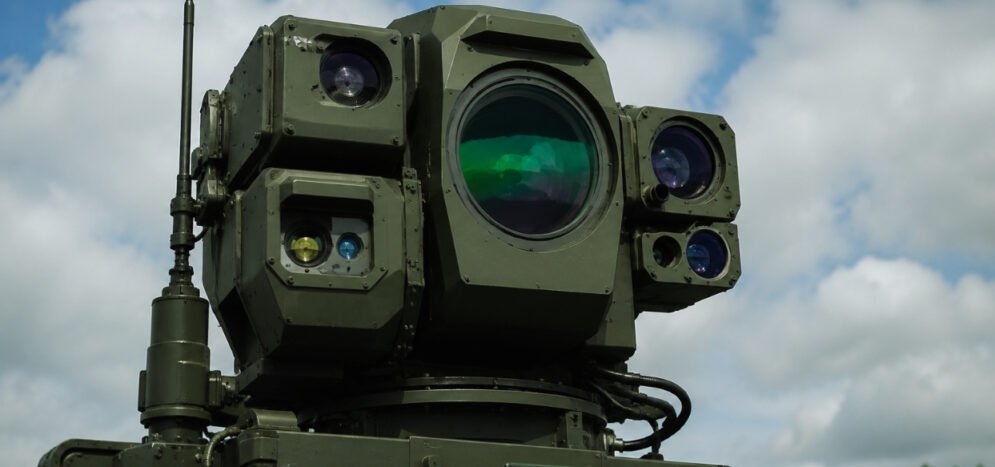
Electro-optical and infrared sensors provide military forces with detailed visual and thermal information. These systems are widely used on fighter aircraft, helicopters, armored vehicles, naval platforms, unmanned aerial vehicles, and surveillance systems. Infrared sensors are particularly valuable for detecting targets in darkness and challenging visibility conditions.
Electronic warfare sensors are designed to detect, identify, locate, and analyze electromagnetic emissions. They support electronic intelligence, communications intelligence, threat warning, and electronic countermeasure operations. As military forces increasingly depend on the electromagnetic spectrum, these sensors are becoming essential for maintaining operational awareness.
Acoustic sensors are particularly important in naval warfare. Sonar systems can detect and track submarines, underwater vehicles, mines, and other objects beneath the water. Similarly, acoustic gunshot and weapon-detection systems can help identify hostile fire in land-based environments.
Other military sensors include chemical and biological sensors, pressure sensors, magnetic sensors, laser-based systems, radiation sensors, and multispectral sensing technologies. Combining information from multiple sensor types can provide a more comprehensive picture of the battlefield.
Applications Across Modern Defense Platforms
Military sensors are deployed across virtually every major defense platform. Fighter aircraft use radar, infrared search and track systems, electronic support measures, and electro-optical sensors to detect threats and improve targeting. These systems can work together to provide pilots with information about aircraft, missiles, ground targets, and electromagnetic activity.
Naval platforms use a combination of surface-search radar, air-defense radar, sonar, electro-optical systems, and electronic warfare sensors. Integrated sensor networks allow warships to monitor large areas and respond to threats such as aircraft, missiles, submarines, and unmanned systems.
Ground forces increasingly rely on sensors for battlefield surveillance, target acquisition, perimeter security, and reconnaissance. Armored vehicles can integrate thermal cameras, laser rangefinders, radar, and other sensors to improve crew awareness and engagement capabilities.
Unmanned systems are another major growth area for military sensor technology. UAVs, unmanned ground vehicles, and unmanned surface and underwater vehicles can carry advanced sensor payloads while reducing risks to personnel. Persistent surveillance from unmanned platforms can provide continuous intelligence over large operational areas.
Space-based sensors also play an increasingly important role. Satellites equipped with optical, infrared, radar, and other sensing technologies can provide intelligence over large geographic areas. Combining space-based information with airborne and ground-based sensors can support a broader defense intelligence architecture.
Sensor Fusion and Artificial Intelligence
One of the most significant developments in military sensor technology is the integration of sensor fusion and artificial intelligence. A single sensor may provide only a partial understanding of a target or environment. Sensor fusion combines information from multiple sources to generate a more complete and reliable operational picture.
For example, radar may detect an object while an electro-optical sensor provides visual identification and an electronic warfare sensor determines whether the object is transmitting electromagnetic signals. Artificial intelligence can help process these large volumes of data, identify patterns, classify potential threats, and prioritize information for operators.
AI-enabled sensors can also support automated target recognition, anomaly detection, predictive maintenance, navigation, and autonomous decision-support systems. This is particularly important as the number of sensors deployed across modern battlefields continues to increase.
Emerging Trends in Military Sensors
The future of military sensors technology is being shaped by several important trends. Multi-function Military Sensors technology are being developed to perform several sensing tasks within a single system, potentially reducing size, weight, power consumption, and platform integration requirements.
Gallium nitride-based electronics are improving the capabilities of advanced radar and electronic warfare systems. Meanwhile, infrared and electro-optical technologies are becoming more sensitive and compact. Distributed sensor networks are also gaining importance, allowing multiple platforms to cooperate and share information across a battlefield.
Quantum sensing is another emerging technology with potential defense applications. Quantum-based systems could eventually provide highly sensitive measurements for navigation, magnetic-field detection, timing, and other military applications. Although many applications remain under development, the technology is attracting significant research interest.
The increasing use of autonomous platforms is also creating demand for lightweight, low-power, high-performance sensors. Future unmanned systems may combine radar, cameras, infrared sensors, lidar, electronic support systems, and other technologies to operate with greater levels of autonomy.
Challenges in Military Sensor Technology
Despite rapid technological development, military sensor systems face several challenges. Military Sensors technology must operate reliably in extreme temperatures, vibration, dust, moisture, electromagnetic interference, and other harsh conditions. They must also provide accurate information despite camouflage, concealment, deception, weather effects, and electronic warfare.
Another major challenge is managing the enormous quantity of data generated by modern sensor networks. Military organizations need advanced computing, communications, artificial intelligence, and cybersecurity capabilities to convert raw sensor data into useful intelligence.
Power consumption is also an important consideration, particularly for unmanned platforms and dismounted soldiers. Reducing the size and energy requirements of sensors while maintaining performance remains a key engineering objective.
Future Outlook
Military sensors technology is expected to remain a fundamental area of defense innovation. Future systems will increasingly move from standalone sensors toward interconnected, intelligent, and distributed sensing networks.
The combination of radar, electro-optical, infrared, acoustic, electronic warfare, satellite, and other sensing technologies will enable armed forces to develop more comprehensive situational awareness. Artificial intelligence and sensor fusion will further improve the ability to process information and identify potential threats in real time.
As warfare becomes increasingly connected and autonomous, military sensors will serve as the foundation for intelligence, surveillance, reconnaissance, targeting, navigation, and decision-making. Countries investing in advanced sensing technologies, resilient networks, AI-enabled processing, and next-generation sensor architectures will be better positioned to maintain an information advantage on future battlefields.
Conclusion
Military sensors technology is transforming how defense forces detect threats, collect intelligence, understand the battlefield, and conduct military operations. Advanced radar, infrared, electro-optical, acoustic, electronic warfare, and multispectral sensors are increasingly being integrated into connected defense architectures.
The future will be defined not simply by better individual sensors, but by the ability to combine information from multiple Military Sensors technology and platforms into a real-time, intelligent operational picture. With continued advances in artificial intelligence, sensor fusion, miniaturization, autonomous systems, and advanced electronics, military sensors are set to become even more important to next-generation defense capabilities.