
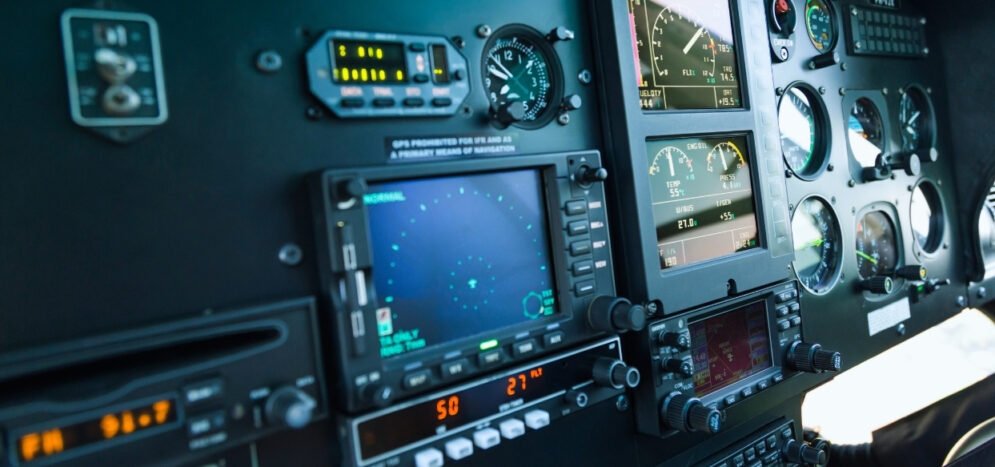
Defense avionics technology has become one of the most important foundations of modern military aviation. From fighter jets and transport aircraft to unmanned aerial vehicles and airborne early-warning platforms, avionics systems determine how effectively an aircraft can sense its surroundings, communicate with other assets, navigate complex environments, and engage threats. As military operations become increasingly network-centric, the integration of advanced sensors, artificial intelligence, electronic warfare, secure communications, and mission computers is transforming the role of avionics from a supporting function into a central element of combat capability.
Modern defense avionics combines hardware and software to provide aircraft with situational awareness, mission management, navigation, flight control, communications, targeting, and threat-detection capabilities. The growing complexity of the battlefield is driving defense organizations to invest in avionics that can process large volumes of information quickly while remaining reliable under demanding operational conditions.
Evolution of Defense Avionics
Early military aircraft relied heavily on mechanical instruments and basic radio systems. As aircraft technology advanced, analog electronics began supporting navigation, communication, and weapons delivery. The introduction of digital computing represented a major shift, allowing multiple aircraft systems to share information and perform increasingly complex calculations.
Modern aircraft now use highly integrated digital architectures. Mission computers can combine information from radar, electro-optical sensors, electronic-support systems, navigation equipment, and external data sources. This integration gives pilots a more comprehensive view of the operational environment and reduces the workload associated with managing individual systems.
The evolution from standalone avionics toward integrated architectures has also encouraged the adoption of modular and open-system designs. These approaches allow military operators to introduce new capabilities without completely replacing an aircraft’s existing avionics architecture.
Core Components of Defense Avionics
Defense avionics consists of numerous interconnected systems, each supporting a specific operational requirement. Mission computers form the central processing element of many modern aircraft, managing sensor data, weapons information, navigation inputs, communications, and mission functions.
Radar remains another critical component. Active electronically scanned array (AESA) radars provide advanced detection, tracking, and targeting capabilities while offering greater flexibility than traditional mechanically scanned systems. AESA technology is increasingly being incorporated into fighter aircraft, airborne surveillance platforms, and other military systems.
Electro-optical and infrared systems complement radar by providing visual and thermal information. These sensors can support target identification, surveillance, navigation, and precision engagement, particularly in situations where radar use may be undesirable.
Navigation systems are equally important. Modern military aircraft combine inertial navigation, satellite navigation, terrain information, and other inputs to maintain accurate positioning. In contested environments where satellite signals may be degraded or unavailable, aircraft increasingly require resilient navigation technologies.
Communication and data-link systems connect aircraft with other platforms and command centers. Secure tactical data links allow aircraft to exchange information with other fighters, airborne surveillance platforms, naval vessels, ground forces, and command networks.
Sensor Fusion and Situational Awareness
One of the most significant developments in defense avionics is sensor fusion. Instead of presenting pilots with information from individual sensors separately, modern avionics can combine multiple data sources into a unified operational picture.
For example, a fighter aircraft may receive information from its radar, infrared search and track system, electronic-support measures, onboard navigation equipment, and external platforms. Sensor-fusion technologies can process these inputs and present relevant information through a common interface.
This capability can improve situational awareness and reduce the time required for pilots to identify threats. In complex combat environments, the ability to detect, classify, and respond to potential threats rapidly can provide a significant operational advantage.
Artificial Intelligence and Software-Defined Avionics
Artificial intelligence is emerging as an important technology within defense avionics. AI-enabled systems can support tasks such as sensor-data processing, anomaly detection, threat classification, mission planning, and decision support.
Rather than replacing pilots, AI is increasingly being developed as a tool for helping crews manage the growing volume of information generated during military operations. Automated systems can prioritize information and highlight potential threats, allowing pilots to focus on higher-level tactical decisions.
Software-defined avionics is also changing aircraft modernization. Instead of relying exclusively on hardware upgrades, software updates can introduce new capabilities, improve algorithms, enhance cybersecurity, and optimize system performance.
This approach can reduce the time and cost associated with upgrading aircraft throughout their operational lives. However, it also creates a greater need for rigorous software testing, certification, cybersecurity, and configuration management.
Electronic Warfare and Cybersecurity
Modern aircraft operate in environments where electromagnetic spectrum control is increasingly important. Electronic warfare avionics can detect, identify, and respond to hostile radar and communication activity.
Electronic-support systems can monitor electromagnetic emissions and provide information about potential threats. Electronic countermeasure systems can then help protect aircraft against radar-guided weapons and other electronic threats.
Cybersecurity has become equally important because modern aircraft depend heavily on interconnected digital systems. Mission computers, communications systems, data links, sensors, and maintenance networks can create potential attack surfaces.
Defense avionics technology therefore increasingly incorporates secure architectures, encryption, access controls, intrusion detection, and resilient communications. Cybersecurity must be considered throughout the aircraft lifecycle rather than added only after the avionics system has been developed.
Open Architecture and Modular Upgrades
Military aircraft often remain in service for several decades. During this period, threats, technologies, and mission requirements can change considerably. This makes upgradeability a major consideration in avionics development.
Open architecture approaches can help military operators integrate new sensors, processors, displays, and software without redesigning an aircraft’s entire avionics system. Modular systems can also simplify maintenance and reduce dependence on proprietary technologies.
Technologies such as open mission systems are encouraging greater interoperability between equipment supplied by different manufacturers. This can provide defense organizations with greater flexibility when selecting future upgrades.
Future Outlook
The future of Defense avionics technology will be shaped by greater automation, advanced processing, networking, and distributed sensing. Artificial intelligence is expected to play a larger role in analyzing sensor information and supporting mission decisions.
Edge computing will also become increasingly important. Processing information closer to where it is generated can reduce latency and minimize the amount of data that must be transmitted across tactical networks.
Meanwhile, manned-unmanned teaming is creating new avionics requirements. Fighter aircraft may increasingly operate alongside autonomous or semi-autonomous unmanned platforms that provide surveillance, electronic warfare, decoy, or strike capabilities. Avionics systems will need to support secure communication and coordinated operations between these platforms.
Quantum-resistant cybersecurity, advanced human-machine interfaces, high-performance processors, and resilient navigation technologies are also likely to influence future development.
Conclusion
Defense avionics technology is evolving from a collection of individual aircraft electronics into an integrated digital ecosystem. Radar, sensors, mission computers, communications, navigation, electronic warfare, artificial intelligence, and cybersecurity are increasingly connected to provide military aircraft with greater situational awareness and operational flexibility.
As modern conflicts become more dependent on information superiority, avionics will play an increasingly central role in determining aircraft effectiveness. Future systems will need to process more information, respond faster, operate in contested environments, and remain adaptable throughout an aircraft’s service life.
The combination of open architectures, AI-enabled processing, advanced sensors, secure networking, and modular upgrades will therefore shape the next generation of military aviation. For defense organizations, investing in adaptable and resilient avionics will be essential to maintaining airpower capabilities against increasingly sophisticated threats.