

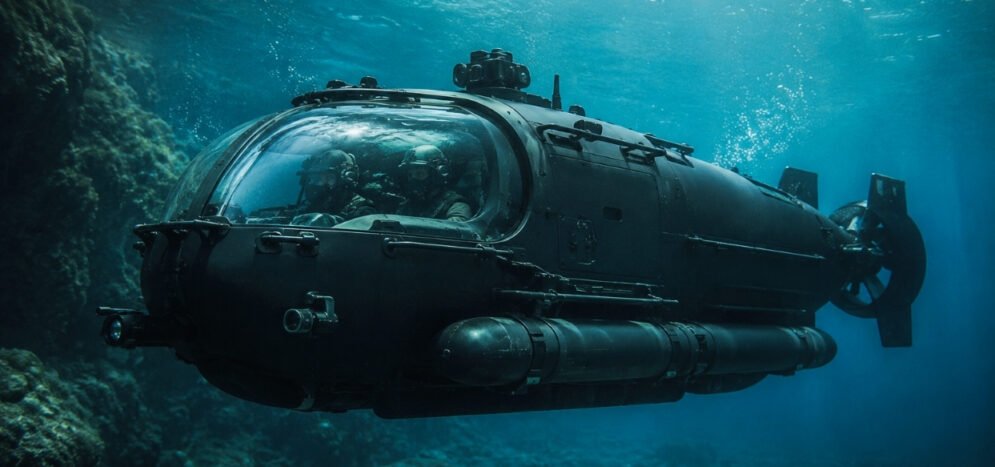
Combat Submersible Vehicle Technology are becoming an increasingly important capability in modern naval and special operations. Designed to transport personnel and equipment underwater or conduct specialized missions in contested maritime environments, these platforms combine stealth, mobility, advanced navigation, and underwater endurance.
Unlike conventional submarines, combat submersibles are generally smaller and optimized for specific missions. They are often used by naval special forces to deploy personnel close to hostile coastlines, offshore installations, ships, or other strategic locations while reducing the risk of detection. As maritime competition increases and coastal areas become more heavily monitored, the technology behind these underwater platforms is advancing rapidly.
Modern combat submersible vehicle technology is evolving through improvements in propulsion, batteries, navigation, communications, sensors, materials, and automation. These developments are expanding the operational range and flexibility of underwater special operations.
The Role of Combat Submersible Vehicles
Combat submersibles are primarily designed to support covert maritime operations. Their main advantage is the ability to move personnel and equipment through the underwater environment, where they are more difficult to detect than surface vessels or aircraft.
A typical mission may involve launching the vehicle from a submarine, surface ship, or specialized support vessel. The combat submersible then transports special operations personnel toward a designated area. Depending on the vehicle design, operators may travel in a wet environment exposed to surrounding water or within a dry, pressurized compartment.
Combat submersibles can support missions such as maritime reconnaissance, intelligence collection, special operations insertion and extraction, underwater surveillance, mine-related activities, and the inspection of critical maritime infrastructure. Their small size also allows them to operate in shallow coastal waters and other environments where larger submarines may face limitations.
The growing importance of undersea infrastructure, including communication cables, energy pipelines, and offshore installations, is creating additional interest in specialized underwater platforms capable of monitoring and operating around critical maritime assets.
Advances in Propulsion and Energy Systems
Propulsion and energy storage are among the most important areas of combat submersible development. Traditional underwater vehicles have faced limitations related to battery capacity and endurance. Improvements in energy technology are helping extend operational range while supporting additional onboard systems.
Lithium-ion battery technology has become increasingly important because it can provide higher energy density than many conventional battery systems. Improved battery management systems are also helping operators monitor power consumption and optimize energy use during missions.
Electric propulsion offers another advantage by reducing acoustic signatures. Quiet operation is essential for combat submersibles operating near hostile coastlines or maritime assets. Modern electric motors and propulsion systems are being designed to reduce vibration and underwater noise while maintaining sufficient maneuverability.
Future platforms may also benefit from developments in advanced battery chemistry, fuel cells, and hybrid power systems. Greater energy capacity could allow combat submersibles to remain deployed for longer periods and operate farther from their launch platforms.
Navigation, Sensors, and Underwater Situational Awareness
Navigation is particularly challenging underwater because satellite navigation systems such as GPS cannot be directly used while submerged. Combat submersibles therefore depend on a combination of inertial navigation systems, sonar, Doppler velocity logs, underwater terrain data, and other positioning technologies.
Modern inertial navigation systems can track the movement of the vehicle from a known starting point. However, positioning accuracy can gradually decline over long distances. To address this challenge, advanced navigation systems can combine information from multiple sensors to improve overall accuracy.
Sonar technology is also critical for detecting obstacles, identifying underwater terrain, and supporting navigation in complex environments. Forward-looking sonar can help operators avoid hazards, while side-scan and other sonar technologies can support reconnaissance and underwater mapping.
Sensor fusion is becoming an important technology trend. By combining information from sonar, navigation systems, cameras, environmental sensors, and other equipment, combat submersibles can provide operators with a more complete understanding of the underwater environment.
Communication and Connectivity Challenges
Maintaining communication with underwater vehicles remains a significant technological challenge. Radio-frequency signals do not travel effectively through seawater, particularly at greater depths. Combat submersibles therefore rely on specialized communication methods.
Acoustic communication can transmit information underwater over relatively long distances, although data rates are limited and communication may be affected by environmental conditions. Other systems may use extremely low-frequency signals for specific applications.
Modern combat submersible operations are increasingly exploring methods of sharing information between underwater vehicles, submarines, surface ships, and command centers. Autonomous communication nodes, underwater sensor networks, and deployable communication buoys could improve connectivity while reducing the need for the submersible to surface.
However, communication systems must balance connectivity with operational security. Transmissions can potentially increase the risk of detection, making low-probability-of-intercept and secure communication technologies particularly important.
Automation and Autonomous Technologies
Automation is expected to play a growing role in the future of combat submersible technology. Advanced control systems can reduce the workload on operators by managing navigation, propulsion, energy consumption, and vehicle stability.
Autonomous and semi-autonomous capabilities could allow submersibles to perform selected tasks with reduced human intervention. For example, automated navigation systems may help a vehicle follow a predetermined route, avoid obstacles, or maintain a specific position near an underwater structure.
Artificial intelligence and advanced software could further improve underwater decision support. AI-enabled systems may analyze sensor data, identify unusual objects, detect environmental changes, and assist operators in making faster decisions.
Autonomous underwater vehicles are also likely to work alongside crewed combat submersibles. Uncrewed platforms could conduct preliminary reconnaissance, map underwater routes, inspect infrastructure, or gather environmental data before personnel enter a high-risk area.
This combination of crewed and uncrewed systems could create a more flexible approach to underwater operations.
Vehicle Design, Materials, and Survivability
Modern combat submersibles must balance strength, weight, hydrodynamic efficiency, and payload capacity. Advanced materials and manufacturing techniques are helping designers improve vehicle performance while reducing weight.
High-strength alloys, composites, and specialized coatings can improve resistance to seawater corrosion and demanding underwater conditions. Hydrodynamic design is equally important because an efficient hull shape can reduce energy consumption and improve endurance.
Low acoustic signatures are another major design requirement. Machinery isolation, improved propulsion systems, and noise-reduction technologies can help reduce the likelihood of detection by underwater sensors.
Survivability also depends on system reliability. Combat submersibles may operate far from immediate support, making redundant navigation, life-support, propulsion, and communication systems important for crew safety and mission success.
The Future of Combat Submersible Technology
Combat submersible technology is moving toward platforms that are quieter, more autonomous, digitally connected, and capable of operating over longer distances. Improvements in batteries, propulsion, sensors, and navigation are expected to expand the range of missions these vehicles can perform.
The integration of crewed submersibles with autonomous underwater vehicles may become one of the most important developments in the sector. A larger underwater system could include a crewed platform, autonomous reconnaissance vehicles, deployable sensors, and communication nodes operating together as a coordinated network.
Digital engineering and simulation will also accelerate development. Engineers can use digital models to test hull designs, energy consumption, sensor placement, and mission profiles before building physical prototypes. This can reduce development costs and improve the performance of future platforms.
As maritime security requirements evolve, the ability to operate discreetly beneath the surface will remain strategically valuable. Combat submersible vehicles offer armed forces a specialized capability for accessing difficult environments, supporting naval special operations, and conducting missions where conventional surface or airborne platforms may be more easily detected.
With advances in energy storage, autonomous systems, underwater communications, and sensor technology, combat submersibles are likely to become more capable and versatile. Their future development will play an important role in shaping the next generation of undersea and special operations capabilities.