

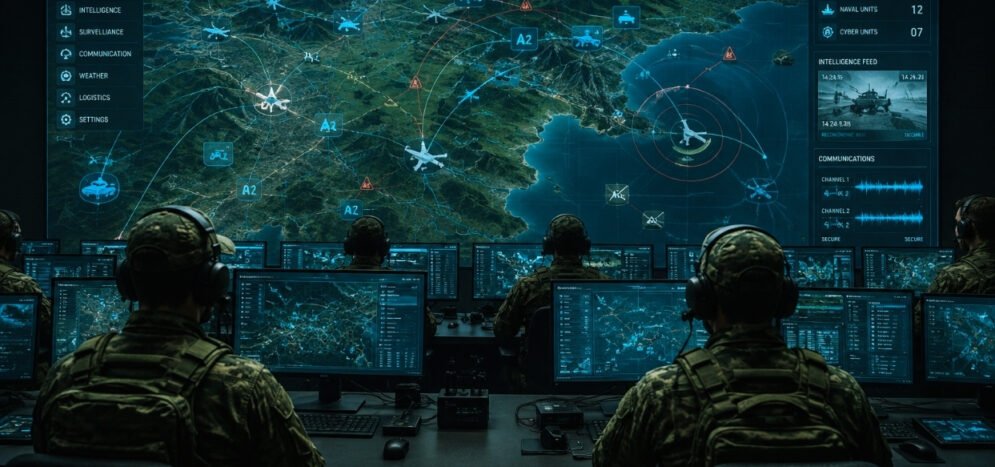
Modern military operations are becoming increasingly connected, data-driven, and dependent on rapid decision-making. Defense Battlefield Management System (BMS) technology has emerged as a critical capability for armed forces seeking to coordinate personnel, platforms, sensors, weapons, and command centers across complex operational environments. A BMS integrates information from multiple sources and presents commanders with a common operational picture, enabling them to understand battlefield conditions and respond more effectively.
As defense forces modernize their command-and-control infrastructure, BMS technology is increasingly being integrated with artificial intelligence, secure communications, unmanned systems, electronic warfare, satellite networks, and advanced sensors. These developments are transforming how military units collect information, share intelligence, coordinate missions, and manage resources.
Introduction to Defense Battlefield Management System Technology
A Defense Battlefield Management System is an integrated command, control, communications, computers, intelligence, surveillance, and reconnaissance capability designed to support military operations. It connects different elements of a defense force and enables the exchange of information between commanders, combat units, vehicles, aircraft, naval platforms, sensors, and other battlefield assets.
The primary objective of a BMS is to provide commanders and personnel with timely and relevant battlefield information. Instead of relying on isolated communication systems or manually collected reports, modern BMS architectures can consolidate information from multiple sources into a unified operational environment.
A typical system may include command-and-control software, tactical communication networks, geographic information systems, battlefield displays, positioning systems, sensors, and secure data links. Depending on the military requirement, BMS technology can support operations at the tactical, operational, and strategic levels.
Key Components of a Modern Battlefield Management System
Modern BMS technology consists of multiple interconnected components working together to create a real-time or near-real-time battlefield picture. Command-and-control software forms the central layer, allowing commanders to monitor units, assign missions, track movements, and exchange information.
Tactical communication networks are another essential component. These networks enable secure voice, data, and messaging between field units and command centers. Depending on operational requirements, communication can involve radio systems, tactical data links, satellite communications, cellular technologies, or specialized military networks.
Sensors also play a major role. Ground surveillance radars, electro-optical and infrared systems, unmanned aerial vehicles, electronic intelligence systems, and other ISR assets can provide information about the operating environment. The BMS processes and distributes this information to authorized users.
Positioning and navigation technologies help track friendly forces and assets. Digital maps and geographic information systems allow personnel to visualize unit locations, operational boundaries, routes, terrain features, and potential threats.
Secure servers, ruggedized computers, mobile terminals, and command workstations provide the hardware infrastructure needed to operate BMS applications in demanding military environments.
Role of BMS in Battlefield Situational Awareness
One of the most important advantages of Battlefield Management System technology is improved situational awareness. In conventional operations, battlefield information can be fragmented across different units and communication channels. This can make it difficult for commanders to develop an accurate understanding of rapidly changing situations.
BMS technology addresses this challenge by collecting and integrating information from multiple sources. Data can be displayed through digital maps and command interfaces, helping authorized personnel identify friendly forces, potential threats, mission objectives, and changing battlefield conditions.
A common operational picture can also improve coordination between different formations. For example, ground forces can share relevant information with supporting artillery, aviation, reconnaissance, or logistics units. This enables commanders to make decisions based on a broader understanding of the operational environment.
Artificial intelligence and data analytics are expected to further strengthen situational awareness. AI-enabled systems can help identify patterns, prioritize information, detect anomalies, and reduce the amount of raw data that commanders must manually review.
Integration with AI, Drones, Sensors and Network-Centric Warfare
The evolution of BMS technology is closely connected with the rise of network-centric warfare. Modern military forces increasingly seek to connect sensors, decision-makers, and effectors through secure digital networks.
Unmanned aerial vehicles are particularly valuable sources of battlefield information. UAVs can provide surveillance imagery, reconnaissance data, and target-related information to authorized command elements. When integrated into a BMS architecture, this information can contribute to a broader operational picture.
Artificial intelligence can support the processing of large volumes of battlefield data. Machine-learning algorithms may assist with object recognition, information classification, anomaly detection, route analysis, and decision-support functions. However, military organizations generally require robust validation, cybersecurity, human oversight, and operational testing before relying on AI-generated recommendations.
Electronic warfare is another increasingly important consideration. BMS networks must operate in environments where communications and navigation systems may be disrupted or contested. Modern architectures therefore emphasize secure communications, redundancy, encryption, network resilience, and the ability to operate under degraded conditions.
Integration with satellites can further expand the reach of military communications and ISR capabilities, particularly across geographically dispersed operational areas.
Technological Advancements and Market Growth
Several technological developments are influencing the evolution of Defense Battlefield Management Systems. Cloud-enabled architectures, edge computing, AI, advanced encryption, software-defined radios, 5G and tactical networking technologies are contributing to more flexible and scalable systems.
Edge computing is particularly valuable because battlefield environments may have limited connectivity to centralized data centers. Processing information closer to where it is generated can reduce latency and improve operational responsiveness.
Open-system architectures are also becoming increasingly important. Military organizations want systems that can integrate equipment from different suppliers and support future upgrades without completely replacing existing infrastructure. Modular software and hardware architectures can help reduce lifecycle costs and improve interoperability.
The growing adoption of unmanned systems is creating additional demand for BMS capabilities. Ground, aerial, and maritime autonomous platforms can generate substantial amounts of data, increasing the need for systems capable of collecting, processing, and distributing information efficiently.
Defense modernization programs across regions are also supporting demand for advanced command-and-control solutions. Countries are investing in digitized land forces, tactical communications, ISR networks, integrated air defense, and multi-domain operational capabilities, creating opportunities for BMS developers and defense technology companies.
Future Outlook for Defense Battlefield Management Systems
The future of Battlefield Management System technology is expected to focus on greater connectivity, automation, interoperability, cybersecurity, and decision-support capabilities. Military operations are increasingly moving toward multi-domain environments where land, air, sea, space, and cyberspace capabilities must operate together.
Future BMS platforms are likely to incorporate AI-assisted analytics, autonomous sensors, advanced tactical networks, edge computing, and improved human-machine interfaces. Rather than simply displaying battlefield information, next-generation systems will increasingly help commanders interpret information and identify relevant operational options.
Cybersecurity will remain a major priority. As more military assets become connected, protecting networks and data from cyber threats will become essential. Future systems will require stronger encryption, identity management, intrusion detection, resilient architectures, and secure software development practices.
Interoperability will also shape the market. Military operations frequently involve multiple branches of the armed forces and, in some cases, allied forces. BMS platforms capable of securely exchanging information across different systems will therefore become increasingly valuable.
Ultimately, Defense Battlefield Management System technology is evolving from a traditional command-and-control tool into a broader digital backbone for modern military operations. By connecting sensors, personnel, platforms, communications, and decision-making capabilities, BMS technology can help defense forces achieve faster information sharing, improved situational awareness, and more coordinated operations. As militaries continue their digital transformation, investment in resilient, interoperable, and AI-enabled battlefield management capabilities is expected to remain an important area of defense technology development.