

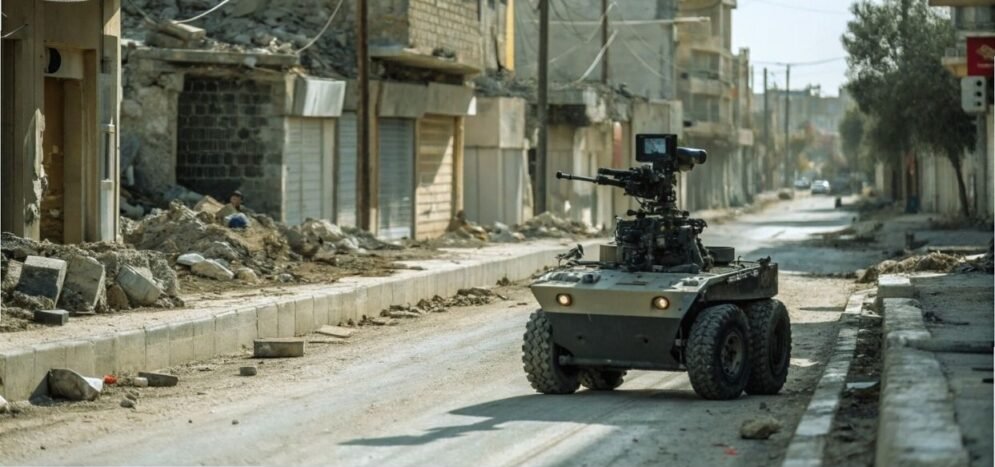
Global Unmanned Ground Vehicles: A Market Transformation
The Evolution of UGVs The unmanned ground vehicle (UGV) industry has evolved significantly. Initially, it was just about remote-controlled bomb robots. However, today it is a multi-billion-dollar ecosystem. Primarily, defense modernization drives this growth. In addition, logistics automation and civilian applications play major roles.
Moreover, AI and sensor fusion have improved drastically. Similarly, power density and secure communications have advanced. Consequently, these technologies have crossed a critical threshold. Truly autonomous systems are no longer experimental; instead, they are deployable and scalable. Furthermore, they are cost-competitive with human-operated alternatives. Ultimately, a convergence of technologies drives this transformation. For instance, military robotics and self-driving cars now fuel each other’s growth. As a result, the UGV market is a dynamic battleground for next-generation mobility.
From Teleoperation to Full Autonomy
The biggest technological leap is the shift to genuine mission-level autonomy. Specifically, modern UGV stacks combine several layered architectures. They use standard robotic middleware for control, and they employ deep-learning perception modules. Notably, these modules learn from millions of real-world kilometers. Furthermore, they utilize tactical reasoning engines.
In parallel, leader-follower convoys have evolved. Previously, they required pre-mapped roads. In contrast, they now operate at highway speeds on rough terrain. Moreover, they re-plan routes if the lead vehicle fails. For example, companies like Anduril and Milrem demonstrate this capability. Consequently, their platoons execute complex missions without human intervention.
Advanced Perception and Sensor Fusion
Historically, early UGVs were fragile in rain or darkness. However, the latest generation solves this issue. Specifically, aggressive sensor fusion closes the gap. For instance, sensor suites now include LiDARs and 4D imaging radars. In addition, thermal cameras are standard.
But the real breakthrough lies in the fusion pipelines. These systems run at 50–200 Hz. As a result, they produce a coherent 3D model. Remarkably, this works even during GPS jamming or zero-visibility conditions. For example, companies like Teledyne FLIR prove this capability. Thus, their UGVs navigate smoke and sandstorms with centimeter-level accuracy.
The Electric Propulsion Revolution
Significantly, battery density has fundamentally changed UGV design. Therefore, silent electric drivetrains are now practical. Specifically, new lithium cells offer high energy density. Additionally, hybrid range-extenders support them. Consequently, medium-sized UGVs now operate for days, not hours.
For instance, platforms like Estonia’s THeMIS are prime examples. They sprint at 50 km/h; furthermore, they climb steep gradients. Their batteries power sensors for 18 hours. Moreover, they recharge quickly from fuel cells. Ultimately, this silent operation forces a rethink of infantry tactics.
Swarm Intelligence and Teaming
Scalable robotic swarming is a futuristic capability that is available today. However, new doctrines avoid treating UGVs as expensive assets. Instead, they use swarms of low-cost robots. Additionally, these robots utilize mesh networking to self-organize.
For example, systems from Israel’s Roboteam demonstrate this power. Swarms flood buildings; simultaneously, they map them. In fact, they locate targets faster than humans. Furthermore, manned-unmanned teaming has matured. Now, a single soldier can supervise multiple UGVs. Consequently, these robots provide overwatch and carry munitions upon command.
Counter-UAS Capabilities
Recently, cheap commercial drones created a need for mobile defense. Fortunately, UGVs fill this gap rapidly. Because they carry heavy power sources easily, they are ideal platforms. For instance, some carry air-burst munitions or high-power microwave payloads. Moreover, NATO armies are even testing laser effectors.
Therefore, these systems support traditional air defense. In effect, they create a protective bubble around forward units. Previously, these units lacked defense against loitering munitions.
Dual-Use Technology Transfer
Notably, investment in warehouse robots drives UGV progress. For example, giants like Amazon lead this charge. Commercial operations demand high reliability; consequently, this produces durable components like motors. Defense applications now repurpose these parts. As a result, they cost a fraction of traditional military equipment.
Conversely, military advances aid the civilian sector. For instance, mining companies operate autonomous truck fleets. Similarly, agriculture sees driverless tractors in unmapped fields. Ultimately, these machines operate with high precision.
Conclusion
Undoubtedly, the global UGV market has passed a turning point. In fact, progress no longer takes decades. Instead, new platforms appear within months. Since technical barriers have fallen, the remaining challenges are doctrine and ethics. However, in the next five years, UGVs will become central components of power. Eventually, they will transform industry and urban services. In conclusion, the robot ground forces have arrived.