
CBRN Technology Insights: Defending Against Invisible Threats
Broadly speaking, CBRN technology safeguards against chemical, biological, radiological, and nuclear hazards by blending detection, protection, and decontamination into a unified defense framework. Specifically, these systems protect military forces, first responders, and civilians from deliberate attacks, industrial accidents, or natural releases of deadly agents. In an era of asymmetric warfare and global risks, CBRN solutions deliver rapid response capabilities that preserve life and restore operations.
Core Components of CBRN Systems
To begin with, CBRN technology hinges on sensors that identify airborne or surface threats in real time. For instance, chemical detectors sniff out nerve agents or blister compounds through ion mobility spectrometry, while biological samplers capture pathogens like anthrax via air filtration and PCR analysis. Similarly, radiological monitors distinguish isotopes with scintillation crystals, and nuclear detectors track gamma emissions.
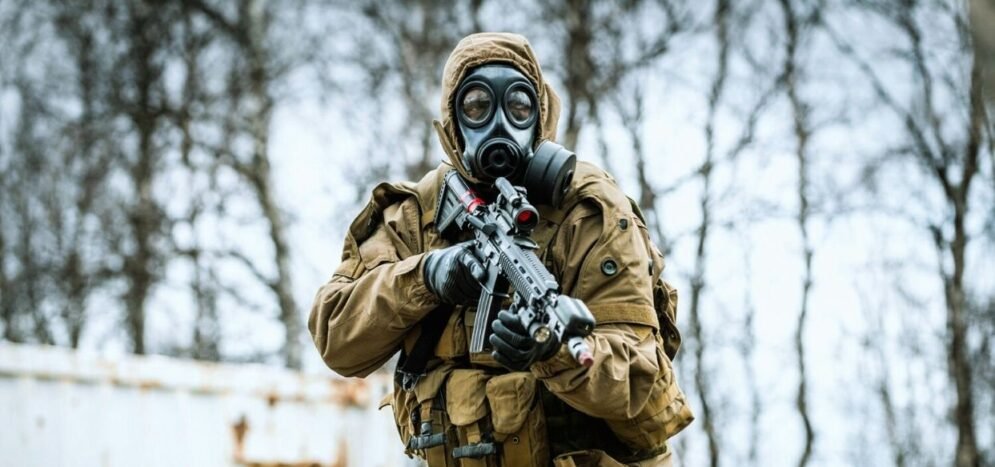
In addition to detection, protective gear includes suits with charcoal layers that adsorb toxins, powered respirators filtering particles to submicron levels, and overboots sealing against splashes. Furthermore, decontamination stations spray reactive foams that neutralize agents on vehicles or skin. Ultimately, command software integrates these feeds, modeling plume spread and prioritizing responses. As a result, mobile labs provide on-scene analysis, confirming threats without lab delays.
Evolution from Cold War Roots
Historically, CBRN defenses trace back to the World War eras, when gas masks countered mustard agents and fallout shelters braced for atomic blasts. Subsequently, the post-Cold War focus shifted to terrorism, birthing networked detectors and broad-spectrum antidotes. Today, digital integration fuses AI with legacy gear, enabling predictive alerts.
Moreover, lessons from incidents like the Tokyo sarin attack or Chernobyl refined modern doctrines, emphasizing speed and scalability. Consequently, modern systems prioritize modularity, allowing operators to swap modules for specific threats without a full system redesign.
Critical Applications in Operations
When it comes to field operations, military units deploy CBRN gear for base defense, scanning perimeters against drone-dispersed agents. Meanwhile, first responders use handheld detectors in urban hazmat calls to guide evacuations. In a similar fashion, airports and ports integrate fixed sensors for cargo screening to halt illicit shipments.
Furthermore, disaster relief teams decontaminate areas after industrial leaks, while hospitals stock autoinjectors for mass exposures. To prepare for these scenarios, training simulations immerse personnel in virtual plumes, honing reflexes under stress.
Driving Forces Behind Innovation
Because non-state actors and rogue states are proliferating, there is a heightened urgency for resilient designs against novel synthetics. At the same time, dual-use tech from the pharmaceutical industry accelerates countermeasure pipelines. As a consequence, international accords standardize equipment, which eases coalition responses.
In light of recent events, pandemic echoes have spotlighted biological defenses, effectively blurring the lines with public health. Because of this, export controls are tightening, favoring nations that are building sovereign capabilities.
Technical Breakthroughs Reshaping Defense
Looking ahead, technical breakthroughs are fundamentally changing the landscape. For example, nanosensors offer palm-sized detection with smartphone interfaces, alerting users via apps. Additionally, CRISPR-based diagnostics can spot engineered bugs in minutes, while smart fabrics self-detoxify vapors to extend wear time.
Moreover, drone swarms can now map contaminated zones and deliver antidotes autonomously. Simultaneously, AI algorithms sift through false positives, and blockchain logs the chain-of-custody for forensics. Finally, portable mass spectrometers identify unknowns on-site, closing critical identification gaps.
Challenges in Deployment and Resilience
However, significant challenges remain. First, agent variability challenges universal detectors, demanding frequent recalibration. Second, harsh environments often degrade suits, requiring materials that are breathable yet impermeable. Because of the logistical burdens of bulky decontamination units, there is a major push for miniaturization.
On a psychological level, the toll of these threats demands training that builds confidence without causing panic. Furthermore, interoperability across different agencies remains elusive, which can hinder joint operations.
Leading Innovators and Ecosystem
Regarding the industry ecosystem, defense primes like Smiths Detection and Bruker dominate with rugged analyzers. Meanwhile, startups pioneer wearable biosensors, partnering with militaries for field trials. In support, chemical giants supply precursor-neutralizing foams, while biotech firms stockpile broad-spectrum vaccines. To ensure readiness, global consortia test interoperability at exercises, forging vital supply pacts.
Regional Strategies and Priorities
Geographically, nations near conflict zones prioritize mobile batteries for rapid setup. In contrast, island chains fortify against sea-borne releases, and urban centers embed sensors in subways and stadiums. Consequently, developing regions adapt low-cost kits for industrial risks, while alliances pool R&D to standardize protocols for shared threats.
Emerging Trends on the Horizon
On the horizon, quantum sensors promise trace-level detection immune to interference. Furthermore, gene-editing prophylactics may soon preempt biological attacks. In the near future, robotic decontamination teams will handle “hot zones” remotely, and space-based early warning systems will track fissile materials globally. Perhaps most impressively, personalized countermeasures will tailor antidotes via individual DNA profiles.
Operational and Strategic Impact
In summary, CBRN technology restores freedom of maneuver post-strike and minimizes operational downtime. By providing credible denial, it deters attackers by raising their costs. When integrated into all-hazards frameworks, it bolsters resilience against accidents or terror alike. Ultimately, CBRN shields preserve societies by turning potential catastrophes into manageable events.